
Brokers Who Actually Get the Job Done
Finding a Commercial Real Estate Broker That Actually Delivers in South Florida
A commercial real estate broker is a licensed professional who represents landlords, tenants, buyers, or sellers in commercial property transactions — including office, retail, industrial, and flex spaces.
If you need a broker fast, here’s what to know:
- Tenant rep brokers work for you, not the landlord — and landlords usually pay their commission
- Look for brokers with local market knowledge in your target area (Doral, Hialeah, Medley, Miami)
- Designations like CCIM or SIOR signal advanced expertise
- Commissions typically run 4–8% of sale price or 3–6% of total lease value
- For small spaces (under 2,000 SF), seek out junior brokers — senior brokers may pass on low-commission deals
Finding the right broker in South Florida isn’t just about who has the most listings. It’s about who understands your market — whether that’s a flex warehouse in Medley, a retail storefront in Hialeah, or a corporate office in Doral.
The wrong broker costs you more than their commission. Hidden lease escalations, unfavorable NNN terms, and missed off-market deals can quietly drain thousands from your bottom line. In a market as competitive and fast-moving as Miami’s, that gap between a good broker and the right one is measured in real dollars.
I’m Brett Sherman, a commercial real estate advisor who has used AI-driven lease benchmarking and tenant-rep strategies to save clients over $120K on single renewals — the kind of work that defines what a great commercial real estate broker actually does. Below, I’ve rounded up the expertise and frameworks that separate brokers who talk from brokers who deliver.
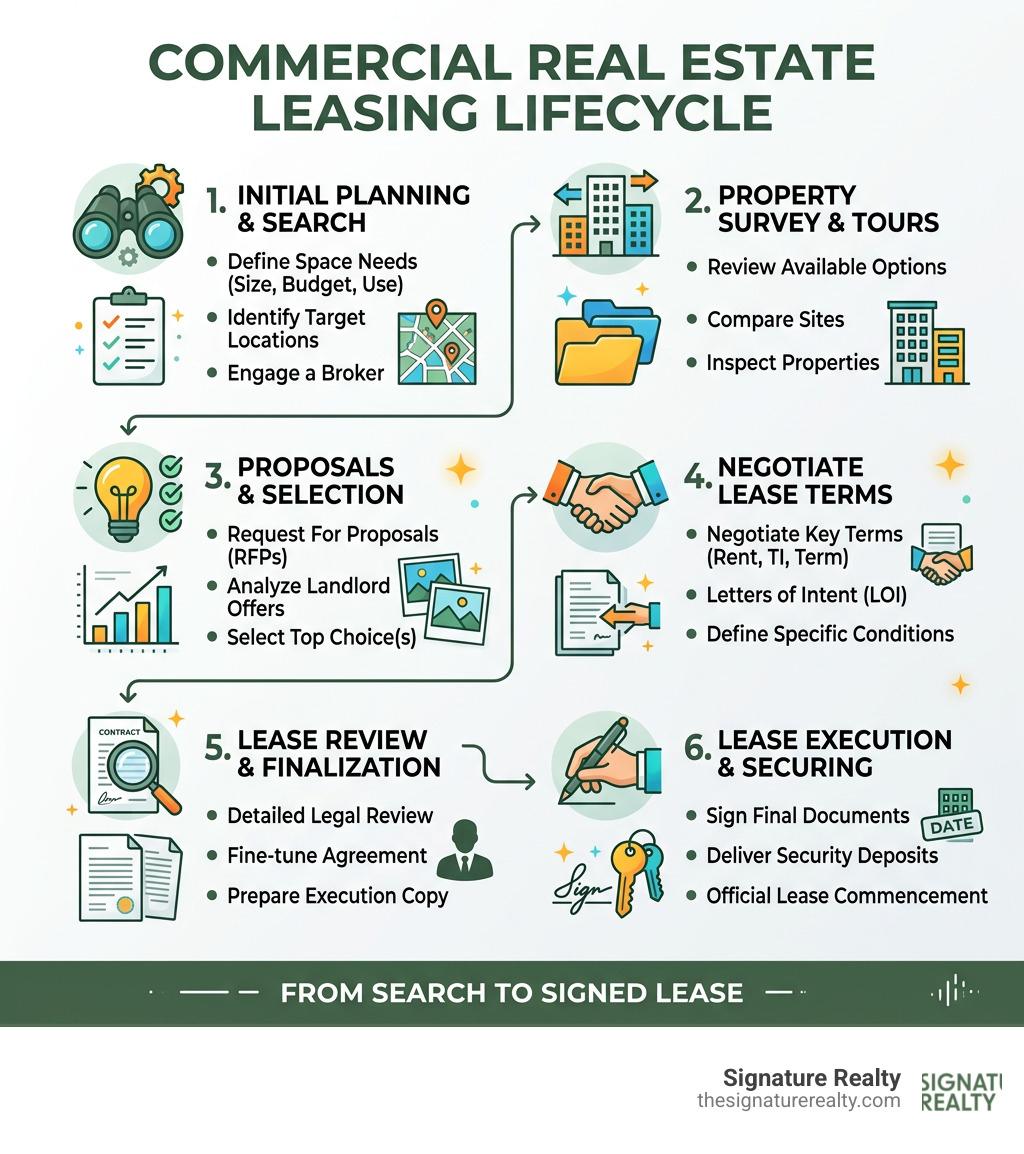
Choosing the Right Commercial Real Estate Broker for South Florida
Navigating the South Florida market requires more than just a license; it requires a deep understanding of the local nuances in areas like Medley and Doral. When you begin your search for a commercial real estate broker, you will likely encounter three different terms: Agent, Broker, and Realtor. While often used interchangeably, the differences are significant for your protection and bottom line.
A commercial real estate agent is licensed to handle transactions but must work under the supervision of a broker. A commercial real estate broker has completed advanced education and can operate their own firm or employ other agents. Finally, a Realtor is a member of the National Association of Realtors (NAR) and is bound by a strict Code of Ethics. In the US, NAR has over 1.5 million members, with roughly 30% of them completing at least one commercial transaction annually.

Understanding Designations and Commissions
When vetting a professional, look for high-level designations. A CCIM (Certified Commercial Investment Member) is essentially the “Ph.D. of commercial real estate,” specializing in financial and market analysis. An SIOR (Society of Industrial and Office Realtors) designation signals a broker is in the top tier of production and experience, particularly for industrial spaces in hubs like Medley.
How do these professionals get paid?
- Sales Transactions: Typically, a commission of 4-8% of the sale price is shared between the listing broker and the buyer’s broker.
- Lease Transactions: Landlord brokers usually earn 3-6% of the total rent paid over the lease term. If you have your own representative, the landlord typically pays both, often splitting the fee.
According to the 2025 Commercial Real Estate Outlook, 88% of global CRE executives expect revenues to increase, yet the market remains complex due to high interest rates. This makes having a data-driven commercial real estate brokerage partner essential for navigating the 2024-2025 landscape.
The Role of a Commercial Real Estate Broker in Miami
In the vibrant Miami market, a commercial real estate broker wears many hats. Their primary role is to act as an expert intermediary, but their loyalty depends on who they represent.
- Tenant Representatives: These brokers work exclusively for the business looking for space. They provide objective advice because their goal is to find the best deal for the tenant, not to fill a specific building.
- Landlord Representatives (Listing Agents): Their fiduciary duty is to the property owner. Their goal is to maximize the rent and minimize the landlord’s concessions.
- Dual Agency: This occurs when one broker represents both sides. While it can streamline communication, it often presents a conflict of interest, as the broker must remain neutral rather than fighting for the best price for either party.
For most businesses in Hialeah or Doral, utilizing a tenant broker is the smartest move. Since the landlord typically pays the commission anyway, you get professional representation, market data, and negotiation leverage at no out-of-pocket cost. As CRE veterans suggest, the best brokers act as consultants who understand your entire business strategy, not just your square footage needs.
How a Commercial Real Estate Broker Navigates South Florida Leases
Lease negotiations in South Florida are notoriously complex. A skilled commercial real estate broker doesn’t just look at the monthly rent; they dissect the entire “Total Contract Value.”
One of the most critical areas of negotiation is the NNN (Triple Net) expenses. In a NNN lease, the tenant pays a pro-rata share of the building’s taxes, insurance, and maintenance. In Miami-Dade, these costs can fluctuate wildly due to rising insurance premiums. A broker ensures these costs are audited and capped where possible.
| Feature | Tenant Representative | Listing Agent (Landlord Rep) |
|---|---|---|
| Fiduciary Duty | To the Tenant | To the Landlord |
| Primary Goal | Minimize rent and maximize concessions | Maximize rent and property value |
| Market Access | Searches entire market, including off-market | Focuses on their specific listings |
| Cost to Client | Usually $0 (Paid by Landlord) | Paid by Landlord |
| Conflict of Interest | Low/None | High (if representing both) |
Beyond the base rent, your broker will negotiate escalations (yearly rent increases) and concessions (like free rent periods or Tenant Improvement allowances). For those looking specifically for office space, an office tenant rep can help navigate the “flight to quality” trend seen in 2024, where businesses are moving to better-equipped buildings even if the footprint is smaller.
Specialized Expertise in Doral, Hialeah, and Medley
The South Florida market is not a monolith. Each sub-market requires a different tactical approach.
- Medley: This is the industrial heart of the region. If you are looking for heavy industrial or logistics space, you need a broker who understands ceiling heights, dock-high loading, and the proximity to the Palmetto Expressway.
- Hialeah: Known for its dense retail and “mom-and-pop” industrial flex spaces. Hialeah requires a broker with “boots on the ground” who knows the local landlords who might not even list their properties on LoopNet or Crexi.
- Doral: The hub for corporate headquarters and high-end retail tenant rep needs. Doral’s market is highly competitive, often requiring a broker who can move fast on “plug-and-play” office suites.
A successful commercial real estate broker in these areas uses “time on task” to build relationships. They know which warehouses in Medley are about to become vacant before the sign even goes up.
Avoiding Pitfalls in Small Business Leasing
Small businesses often face unique hurdles. For example, a entrepreneur looking for a 1,000 SF hair studio might find that many senior brokers won’t take the call. Why? For a 3-year lease at $50/SF, the tenant rep commission might only be $6,000—hardly enough to cover the hours required for a complex build-out negotiation.
Common pitfalls to avoid:
- Personal Guarantees: Landlords in Miami almost always require a personal guarantee, meaning you are personally liable for the rent if the business fails. A good broker works to limit the “burn-down” period of this guarantee.
- The “Residential Friend”: Never use a residential agent for a commercial deal. They often don’t understand NNN expenses, zoning requirements for specific uses (like salons), or the legal nuances of commercial contracts.
- Ignoring the Junior Broker: If you have a small requirement, seek out a hungry junior broker at a reputable firm. They have the time to dedicate to your search and the backing of their firm’s data.
Conclusion
At Signature Realty, we understand that the Miami commercial landscape is evolving. Whether you are expanding a logistics operation in Medley, opening a storefront in Hialeah, or leasing a corporate suite in Doral, the “old way” of doing things—just calling a number on a sign—no longer works.
We bring over 13 years of experience to the table, but we don’t just rely on gut feeling. Our proprietary AI deal analyzer allows us to benchmark your lease against thousands of data points, ensuring you never pay more than market value. Our specialized focus on tenant representation has saved our clients over $2 million in lease negotiations to date.
By combining deep local roots with exclusive access to off-market deals, we provide the “unfair advantage” businesses need to thrive in South Florida. If you are ready to stop searching and start succeeding, we are here to help.
For those looking for more than just a transaction, we also offer expert commercial property management in Miami to ensure your investment continues to perform long after the lease is signed. Let’s get to work.