
Why Smart Negotiation is Key in Miami’s Commercial Market
Knowing how to negotiate a lease on commercial property can save your business thousands and secure its future. For most companies, rent is the second-largest expense after payroll, yet many business owners don’t realize that nearly every lease term is negotiable. In Miami-Dade’s competitive market—from Doral’s industrial corridors to Hialeah’s retail strips—a well-negotiated lease can mean the difference between success and failure.
Quick Steps to Negotiate Your Commercial Lease:
- Research market rates – Know what similar properties are leasing for.
- Understand lease types – Gross vs. Net leases have different cost structures.
- Negotiate key terms – Focus on rent, tenant improvements, and renewal options.
- Seek tenant inducements – Ask for free rent or improvement allowances.
- Get legal review – Have a commercial real estate attorney review the lease.
- Create competition – Consider multiple properties to strengthen your position.
Commercial leases are typically written to favor the landlord, but with the right strategy, you can secure favorable terms. Whether you’re opening a boutique in Doral or a warehouse in Medley, the negotiation process determines your monthly costs and operational flexibility for years to come.
I’m Brett Sherman, and I’ve spent years helping Miami-area businesses master how to negotiate a lease on commercial property using AI-driven market analysis and proven tenant representation strategies. My experience includes saving clients over $200,000 through strategic renewals and reducing negotiation cycles from 45 to 28 days.
Simple how to negotiate a lease on commercial property glossary:
- how to negotiate a commercial lease for retail space
- how to negotiate free rent for a commercial lease
- how long does it take to negotiate a commercial lease
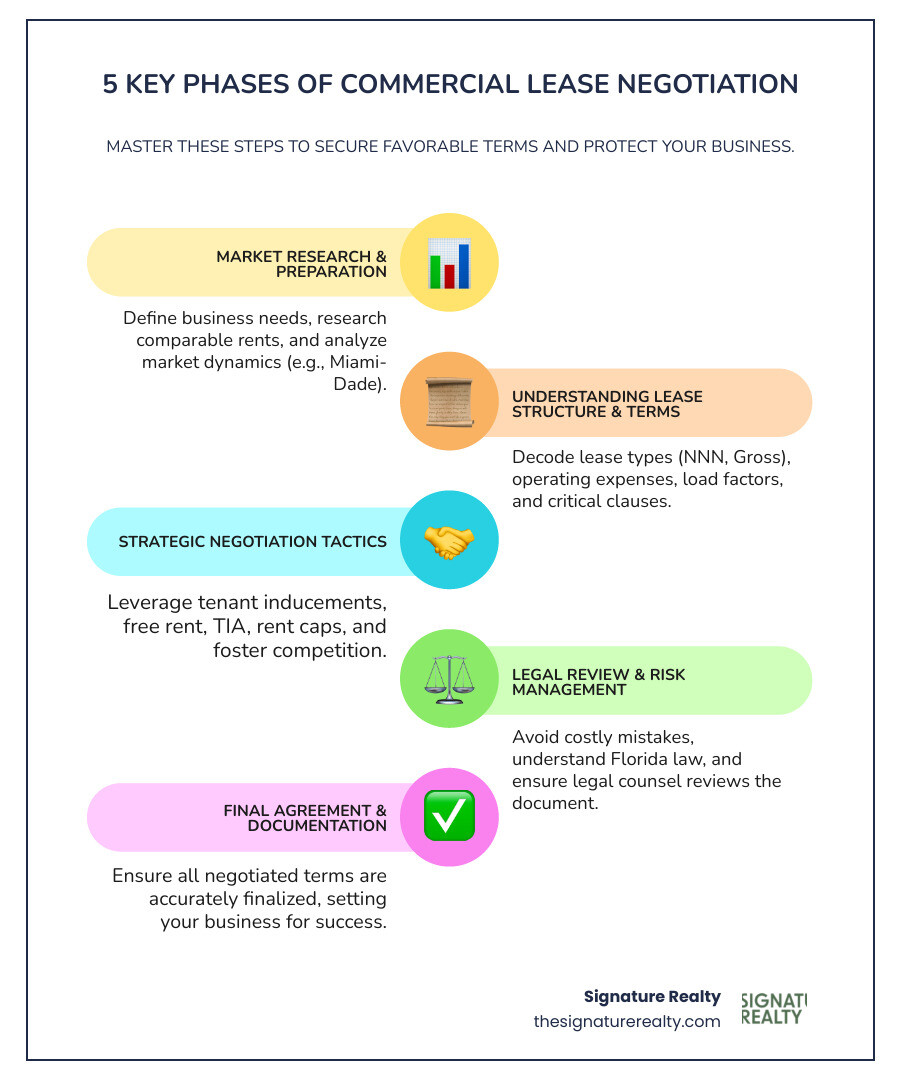
Your Step-by-Step Guide on How to Negotiate a Lease on Commercial Property
Navigating a commercial lease can be complex, as terms are highly customizable. This guide will empower you with the knowledge to secure a lease that benefits your business.
Step 1: Preparation is Power – Know Your Needs and the Market
Thorough preparation is the most critical step. It’s about finding the right space on the right terms to support your business’s growth in the competitive South Florida market.

Define Your Business Needs:
- Square Footage: How much space do you truly need for operations, staff, and future growth?
- Location: Is visibility and foot traffic in Hialeah key, or is proximity to highways in Medley more important? Location often trumps budget.
- Budget: Calculate your maximum monthly occupancy cost, including rent, utilities, and maintenance.
- Long-term Goals: Will you need to expand or downsize in the next 3-10 years? Your lease should allow for this.
Master the Market:
- Comparable Rents (Comps): Research what similar properties in Doral, Hialeah, or Medley are leasing for. This data is your leverage. While a tenant representative has access to the most accurate, real-time data, you can start by researching public listings to drill down into local specifics.
- Vacancy Rates: High vacancy rates in an area give you more negotiating power.
- Current Market Conditions: Post-pandemic, many office buildings have higher vacancies, creating opportunities for tenants. A “tenant’s market” means you have the upper hand. We constantly analyze the real estate market in Miami to keep our clients informed.
- Hybrid Work Models: If you’re using a hybrid model, you may need less space or a different layout, which can be a negotiation point for tenant improvements.
Timing is Everything:
Start lease negotiations 18-24 months in advance, especially for larger spaces. This gives you time to evaluate options without being rushed. The landlord’s first proposal is just a starting point.
Step 2: Decoding the Document – Understanding Lease Types and Key Clauses
Commercial leases are often written to favor the landlord. You must read and understand every clause to negotiate effectively.
Types of Commercial Leases:
| Lease Type | Description -|
| Gross Lease (Full Service) | The tenant pays a flat rental fee, and the landlord covers all property expenses, including property taxes, insurance, and maintenance. This is often the easiest and most predictable for the tenant. |
| Modified Gross Lease | A hybrid between a Gross and Net Lease. The landlord and tenant share responsibility for operating expenses. For instance, the tenant might pay base rent plus their share of utilities, while the landlord covers taxes and insurance. |
| Net Lease (N, NN, NNN) | The tenant pays a lower base rent, plus a portion or all of the operating expenses. |
| Single Net Lease (N) | Tenant pays base rent + property taxes. Landlord covers insurance and maintenance. |
| Double Net Lease (NN) | Tenant pays base rent + property taxes + property insurance premiums. Landlord covers maintenance. |
| Triple Net Lease (NNN) | Tenant pays base rent + property taxes + property insurance premiums + all maintenance costs (including structural repairs). This is common in retail and industrial properties in areas like Medley. |
| Percentage Lease | Tenant pays a lower base rent + a percentage of their gross sales. This type is almost exclusively used for retail businesses in shopping centers, common in Hialeah or Doral retail spaces. |
Key Clauses to Negotiate:
- Rent and Rent Increases: Negotiate the base rent based on market comps. Scrutinize rent escalation clauses and push for caps on increases. Ask for a free rent period, especially if the space has been vacant.
- Operating Expenses (OPEX) & CAM Fees: In Net and Modified Gross leases, these are your share of the building’s costs. Negotiate caps and demand the right to audit these charges.
- Lease Term and Flexibility: A shorter term (1-2 years) with renewal options offers flexibility for new businesses. A longer term (5-10 years) provides stability. Ensure you have options to renew, expand, or even downsize. For more details, see our guide on negotiating a commercial lease renewal.
- Sublease and Assignment: Secure the right to sublease or assign your lease if your business needs change. This provides a critical exit strategy.
- Tenant Improvement (TI) Allowance: Negotiate for the landlord to contribute to the cost of customizing your space. This is crucial for build-outs.
- Use and Exclusivity: The “use” clause should be broad enough for your business activities. An “exclusivity” clause prevents the landlord from leasing to a direct competitor in the same property.
- Termination and Default: Understand the conditions for termination and negotiate a “cure period” that gives you time to fix any potential lease violation before eviction.
Step 3: The Negotiation Playbook – Strategies for Securing Favorable Terms
With your research and understanding of the lease, you’re ready to negotiate.

Building Your Negotiation Leverage:
- Your Value as a Tenant: Highlight your business’s stability and the value you bring to the property.
- Market Conditions: Use high vacancy rates or a “tenant’s market” to your advantage.
- Lease Term: A longer lease commitment can be a bargaining chip for better terms.
- Multiple Options: Always have other potential properties in mind. This gives you the power to walk away.
Key Negotiation Tactics:
- Always Counter: The landlord’s first offer is just that—an offer. Never accept it without a counter.
- Ask for Inducements: Request concessions like free rent periods or a generous Tenant Improvement (TI) allowance.
- Control Costs: Negotiate caps on rent escalations and operating expenses (OPEX/CAM).
- Be Professional: A calm, direct, and polite approach is most effective.
- Prioritize Your Needs: Know your “must-haves” versus your “nice-to-haves.”
- Be Willing to Walk Away: Your strongest position is the ability to say no to a bad deal.
Step 4: Avoiding Costly Mistakes and Navigating Florida Law
A single mistake in a commercial lease can cost you thousands.

Common Mistakes to Sidestep:
- Signing Without Reading: Never sign a lease without a thorough review.
- Ignoring Hidden Fees: Pay close attention to CAM charges, taxes, and other pass-through costs.
- Overlooking Renewal Terms: Negotiate renewal options upfront.
- Not Securing a TI Allowance: Don’t miss the chance to have your landlord help pay for your build-out.
- Operating Without a Lease: A month-to-month arrangement offers no protection.
The Indispensable Role of Professionals:
- Commercial Real Estate Attorney: Always have an experienced real estate lawyer review your lease. They can identify risks and ensure the language protects your interests.
- Tenant Representative/Broker: A tenant-only broker works exclusively for you, not the landlord. They provide market data, find properties, and lead negotiations to get you the best possible terms.
Navigating Florida’s Legal Landscape:
Florida’s commercial real estate laws are specific. Florida Statutes Chapter 83 outlines landlord and tenant rights. Ensure your business name is on the lease (not your personal name) to protect your personal assets. For more on this, see our guide to avoiding bad lease terms in Miami.
Finalizing Your Lease and Gaining a Competitive Edge
You’ve done the research, learned the terms, and are ready to negotiate. The landlord’s first offer is just a starting point. Nearly every term—from rent and improvement allowances to renewal options and CAM fees—is negotiable. Your power comes from being prepared, understanding the market in areas like Doral, Hialeah, and Medley, and having other options.

Why Professional Guidance Makes All the Difference
Even with this guide, navigating a commercial lease is complex. A single mistake can cost you thousands. That’s where an expert tenant representative becomes invaluable.
At Signature Realty, we’ve spent over 13 years mastering the Miami-Dade market. We work exclusively for tenants, so our only goal is to secure the best possible deal for your business. Our data-driven approach and proprietary AI deal analyzer have saved our clients over $2 million by identifying key negotiation points and streamlining the process. We also provide access to exclusive, off-market properties you won’t find anywhere else.
From initial market research to final lease signing, we handle every detail, ensuring you get a lease that supports your business’s growth.
Your Next Steps to Success
Don’t leave your biggest business expense to chance. Let our team of experts turn your lease negotiation into a strategic advantage.
- Ready to find your space? Browse current listings at Find your next commercial property to lease.
- Want to learn more about how we can help? Visit our Tenant Representation Services page.
Let’s work together to secure the perfect space for your business on the best possible terms.