
Miami commercial real estate trends 2026: Expert Insights
Understanding Miami’s Commercial Real Estate Momentum in 2025
Miami commercial real estate trends in 2025 reveal a market transitioning from post-pandemic acceleration to strategic stabilization. This “normalization” isn’t a sign of weakness but of maturation, marked by record-high office rents, robust investor confidence, and sector-specific opportunities across Doral, Hialeah, and Medley.
Key Miami CRE Trends for Q3 2025:
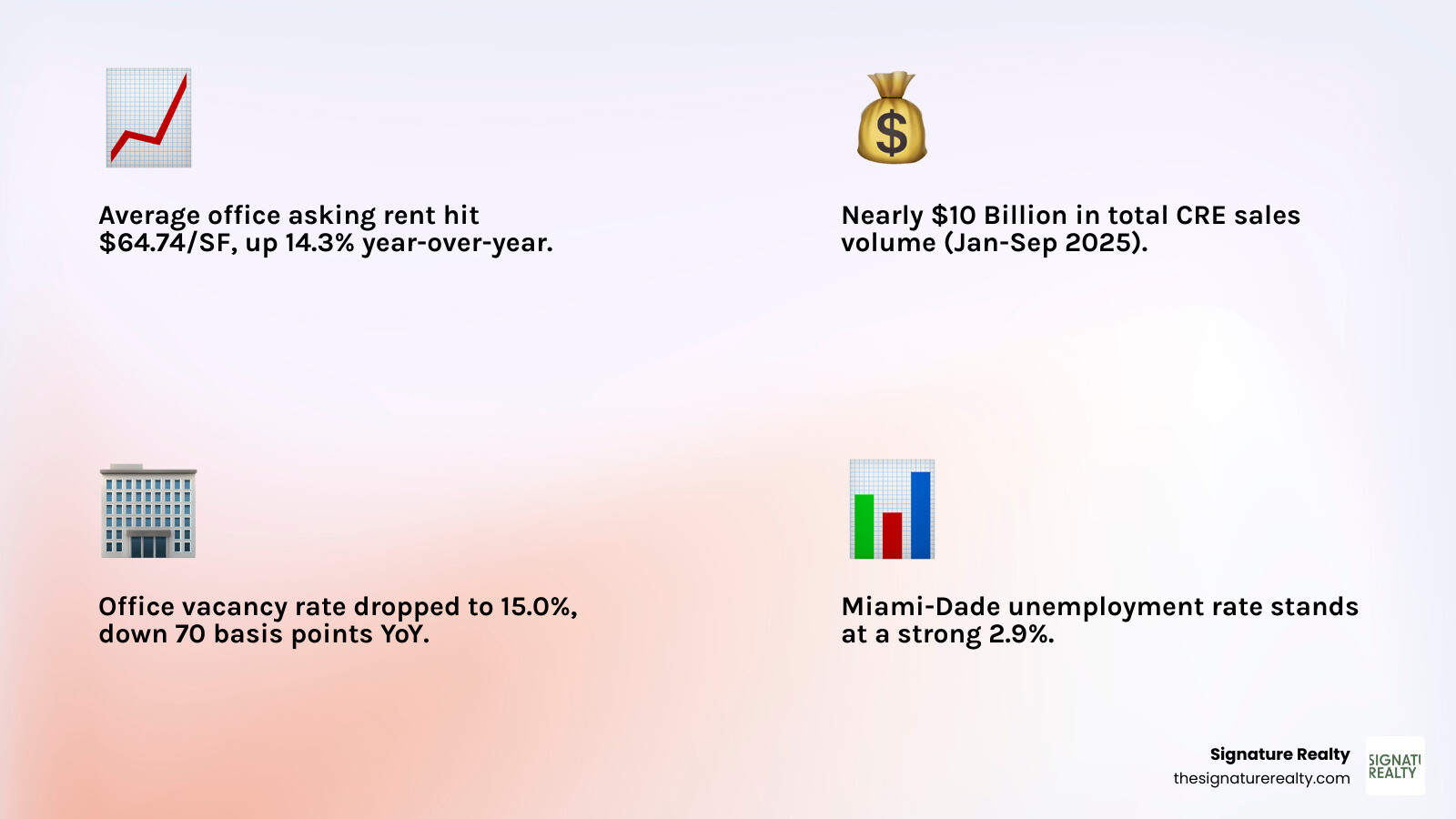
- Office Market: Vacancy dropped to 15.0%, with average asking rents hitting $64.74/SF (up 14.3% YoY). Brickell commands nearly $100/SF.
- Investment Activity: Nearly $10 billion in South Florida CRE sales (Jan-Sep 2025), the strongest volume since 2022.
- Industrial Sector: Vacancy rose modestly to 6%, creating tenant-favorable conditions in Doral, Hialeah, and Medley.
- Economic Strength: Miami-Dade unemployment is low at 2.9% (vs. 4.3% national), with 1.2% YoY employment growth.
- Flight to Quality: Class A office space accounts for 68.4% of leasing, widening the rent spread over Class B to $16.96/SF.
- Construction Pipeline: 1.3 MSF of office space is under construction, with 48% already pre-leased.
- Multifamily Development: Over 50,000 units are under construction across South Florida, focused on transit-oriented locations.
After years of explosive growth, the market is stabilizing. Consistent leasing activity—nearly 920,000 square feet in Q3 2025—signals balanced demand. Investor appetite remains strong, with Miami ranking #2 nationally for investment attractiveness for the second year running.
Three forces are reshaping the landscape:
- The flight to quality: Tenants are paying premiums for Class A space, creating a wide gap between new and aging properties.
- Strategic submarkets: Doral, Hialeah, and Medley are emerging as industrial powerhouses, driven by e-commerce and logistics.
- Policy tailwinds: Florida’s elimination of the 2% commercial lease tax (effective Oct. 1, 2025) provides immediate cost relief.
However, challenges like rising construction costs and significant debt maturities ($14.9 billion due in 2026) require careful navigation. The widening rent gap between Class A and B offices demands a strategic approach to leasing and investing.
I’m Brett Sherman, and for over a decade, I’ve helped businesses in Doral, Hialeah, and Medley steer Miami commercial real estate trends. By combining AI-driven analytics with hands-on tenant representation, we uncover off-market deals and negotiate significant savings—like over $120K in rent for our clients. This guide decodes the data behind Miami’s market and provides actionable strategies for securing the right space at the right terms.
Miami commercial real estate trends terms to learn:
Deep Dive into Miami Commercial Real Estate Trends for 2025/2026
This section analyzes the performance and key trends across Miami’s primary commercial real estate sectors, providing data-driven insights for investors and tenants.
The Office Sector: Flight to Quality and Record Rents
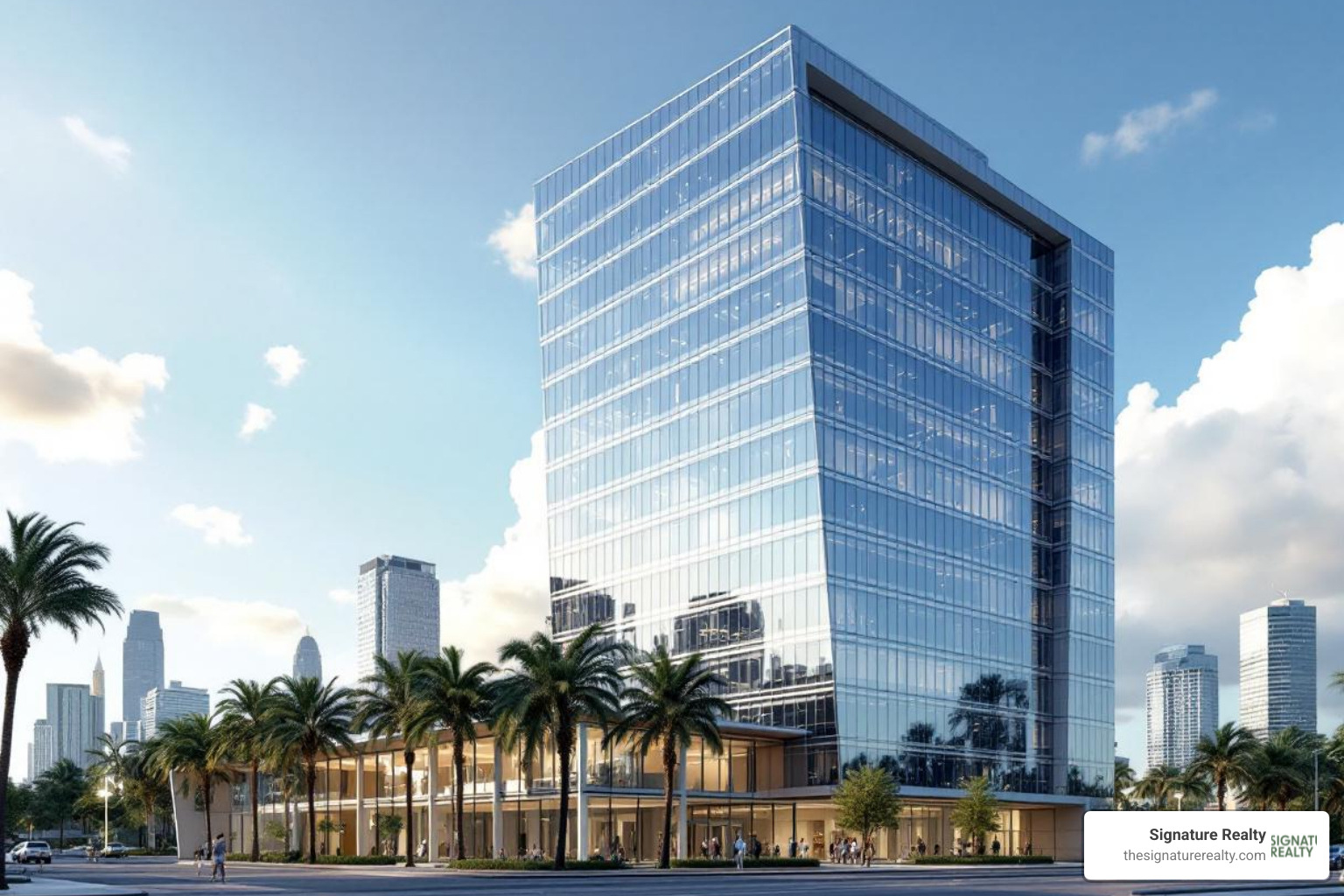
Miami’s office market is defined by a relentless “flight to quality.” Leasing activity remained robust and consistent through 2025, with nearly 920,000 square feet leased in Q3 alone. This healthy demand, combined with positive absorption, pushed the overall vacancy rate down to 15.0%—a year-over-year decrease.
The story is in the segmentation. Class A spaces dominate, accounting for 68.4% of all transactions. This demand is pushing rents to new heights. The average asking rate climbed to $64.74 per square foot (psf), a 14.3% year-over-year jump. The spread between Class A ($70.64 psf) and Class B ($53.88 psf) has widened to nearly $17 psf, underscoring the premium on modern, amenity-rich properties.
Brickell remains the epicenter of this trend, with average asking rents approaching $100 psf and trophy properties commanding over $107 psf. Major developments from firms like Citadel and Banco Santander solidify its status, though many will be owner-occupied, limiting the impact of new supply. For those interested in this vibrant area, we have more info about office space in Brickell.
The development pipeline shows continued confidence, with 1.3 million square feet (MSF) under construction. Crucially, 48% of this new space is already pre-leased, signaling strong future demand.
Industrial Market Dynamics: E-commerce Fuel and Pricing Disconnects
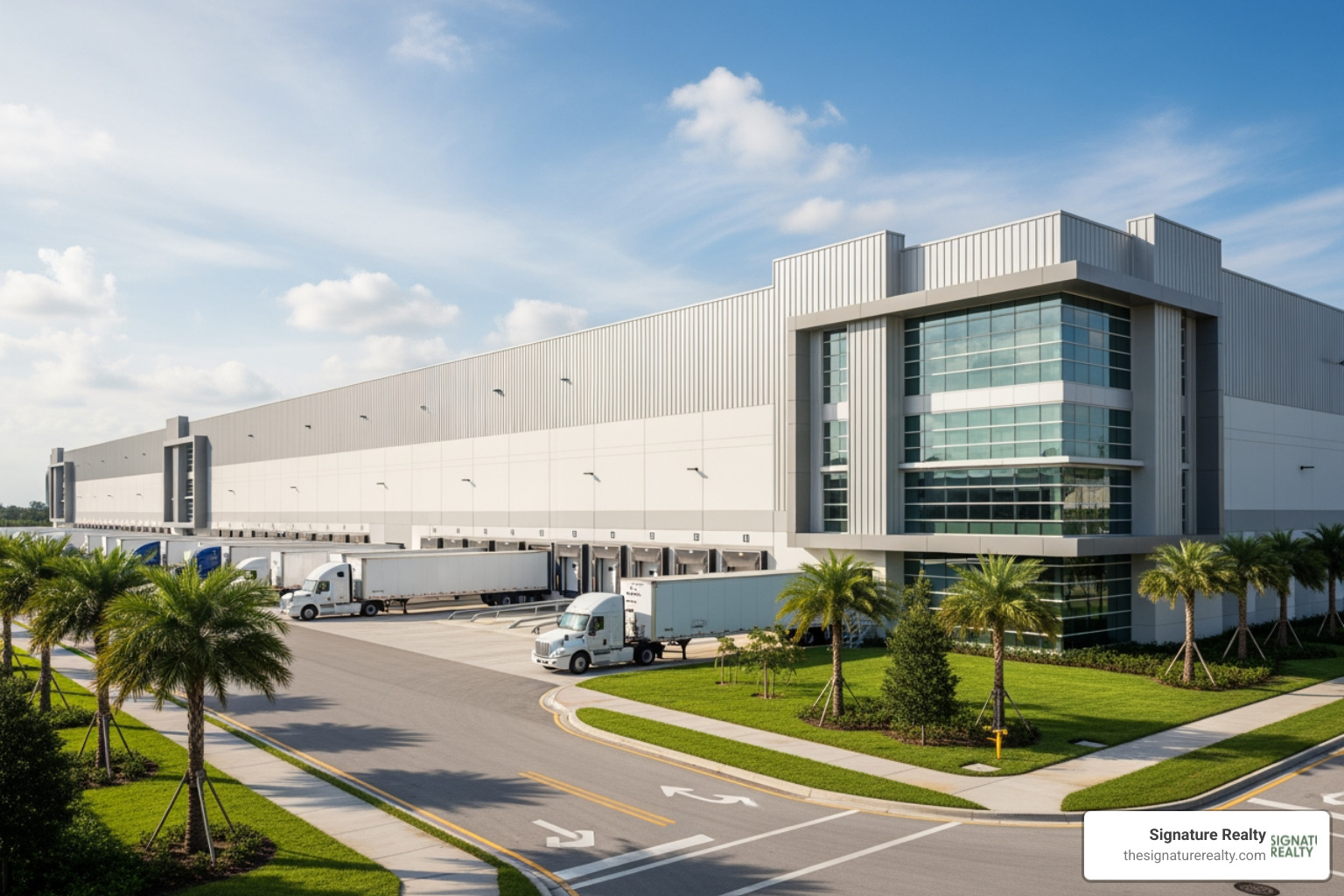
The industrial sector in key submarkets like Doral, Hialeah, and Medley remains a critical engine for South Florida. Fueled by e-commerce, the region is a vital logistics hub demanding modern, high-capacity warehouses near ports and transport networks.
After years of rapid growth, the market is balancing. The vacancy rate has ticked up to 6%, creating a more tenant-favorable environment where landlords are offering incentives like free rent and improvement allowances. However, a “land pricing disconnect”—with sellers asking $3-4M per acre while developers can only justify $2-2.5M—is slowing some new projects. Despite this, user sales are strong, with owner-occupiers paying premiums around $275 psf. Headwinds like rising property taxes, insurance costs, and potential tariff impacts are also creating a more cautious environment.
For an in-depth understanding of this vital sector, explore our Miami Industrial Real Estate Ultimate Guide.
Retail and Multifamily: Stability and Strategic Growth
While office and industrial sectors steer unique dynamics, Miami’s retail and multifamily markets show stability and strategic growth.
| Sector | Vacancy Rate (Q3 2025) | YoY Rent Growth (Q3 2025) | Sales Volume (Jan-Sep 2025) | Key Trend |
|---|---|---|---|---|
| Office | 14.7% – 15.0% | 4.6% – 14.3% | ~$2 Billion (regional office) | Flight to Quality, Record Rents |
| Industrial | 6.0% | Flat to Lower | $130 Million (single large deal) | E-commerce Fuel, Landlord Incentives |
| Retail | Varies (Low 90s – 96%) | High | ~$636 Million (7 outdoor centers) | Experiential, Grocery-Anchored Strength |
| Multifamily | Below National Average | Stabilizing (post-peak) | Largest CRE sales category | Urban Core, Transit-Oriented Development |
South Florida’s retail sector is outperforming many U.S. markets. Grocery-anchored centers boast occupancy rates of 95-96%, and the focus on “experiential” retail blended with dining and entertainment keeps the sector vibrant.
The multifamily market is stabilizing after a period of explosive rent growth. Strong demand from new residents continues to fuel the market, with over 50,000 units under construction, many in dense, transit-oriented urban cores. As borrowing costs ease, the sector is ready for a recovery with stable occupancy and rents.
For investors looking to capitalize on these trends, understanding the nuances of each sector is key. You can find more info on Miami investment properties to guide your decisions.
Navigating the Market: Economic Drivers, Challenges, and Future Outlook
This section explores the economic foundation of Miami’s CRE market, identifies key opportunities and threats, and provides a strategic outlook for anyone looking to invest or lease in Miami, Doral, Hialeah, or Medley.
Key Economic Indicators and Investor Sentiment
Miami’s CRE market is powered by strong economic fundamentals. The region boasts an enviable unemployment rate of 2.9% (well below the 4.3% national average) and steady job growth. This economic vitality has made Miami the #2 most attractive market for CRE investment for the second consecutive year. This sentiment is backed by action: nearly $10 billion in South Florida commercial real estate traded hands in the first three quarters of 2025, the strongest volume since 2022. This flow of capital underscores Miami’s status as a global gateway market.
For a comprehensive understanding of the broader Florida market dynamics, we invite you to explore our Florida Market Reports.
Analyzing Current Miami Commercial Real Estate Trends and Opportunities
A SWOT analysis of the Miami office market, with a focus on Doral, Hialeah, and Medley, reveals a dynamic landscape:
-
Strengths:
- Global Gateway: A diverse economy that attracts international business and capital.
- Resilient Demand: Strong appetite for premium Class A spaces, leading to positive absorption.
- Economic Growth: Low unemployment and consistent job growth fuel commercial activity.
- Successful Revitalization: Thriving submarkets like Wynwood create vibrant commercial ecosystems.
-
Weaknesses:
- High Vacancy in Older Buildings: Class B and C buildings struggle, requiring strategic repositioning.
- Widening Rent Spread: A large rent gap between Class A and B spaces creates affordability challenges.
-
Opportunities:
- Tech Sector Expansion: Miami’s growing tech scene creates significant demand for office space.
- Elimination of Commercial Lease Tax: Florida’s tax elimination (effective Oct. 1, 2025) provides an immediate financial incentive for landlords and tenants. Learn more with our guide on Commercial Property Tax Incentives For Small Business Owners.
- Multi-Use Developments: Integrated live-work-play environments cater to modern urban lifestyles.
-
Threats:
- Rising Interest Rates: Volatile rates impact financing costs and deal viability.
- Construction Costs: High costs can stall new projects and increase rents.
- Remote Work Trends: The long-term impact of hybrid work on overall office demand remains a factor.
Strategic Outlook and Future Miami Commercial Real Estate Trends
Looking ahead, Miami commercial real estate trends point toward continued maturation. A key area to watch is the debt market, with $14.9 billion in CRE debt maturing in 2026. However, with office loans comprising a smaller portion of this total, the risk of a widespread crisis in the sector is low. Furthermore, as new, highly amenitized Class A buildings are delivered, they are expected to be absorbed quickly, helping stabilize overall vacancy rates and reinforcing the “flight to quality” trend.
For businesses in Doral, Hialeah, and Medley, navigating these complexities requires expert guidance. Strategic tenant representation is more crucial than ever. At Signature Realty, our 13+ years of experience are backed by data-driven negotiation strategies. We use a proprietary AI deal analyzer to streamline the leasing process, uncover exclusive off-market deals, and maximize client outcomes. We’ve saved our clients over $2 million in lease negotiations by securing the right space at the best possible terms.
Whether you need a prime office in Brickell or a strategic warehouse in Medley, an expert guide makes all the difference. The future of Miami’s commercial real estate is bright, but it demands informed decisions to open up its full potential. For those with broader real estate interests, you can also navigate Miami’s luxury real estate market with our experts.