
Why Smart Tenants Win at Commercial Lease Negotiations
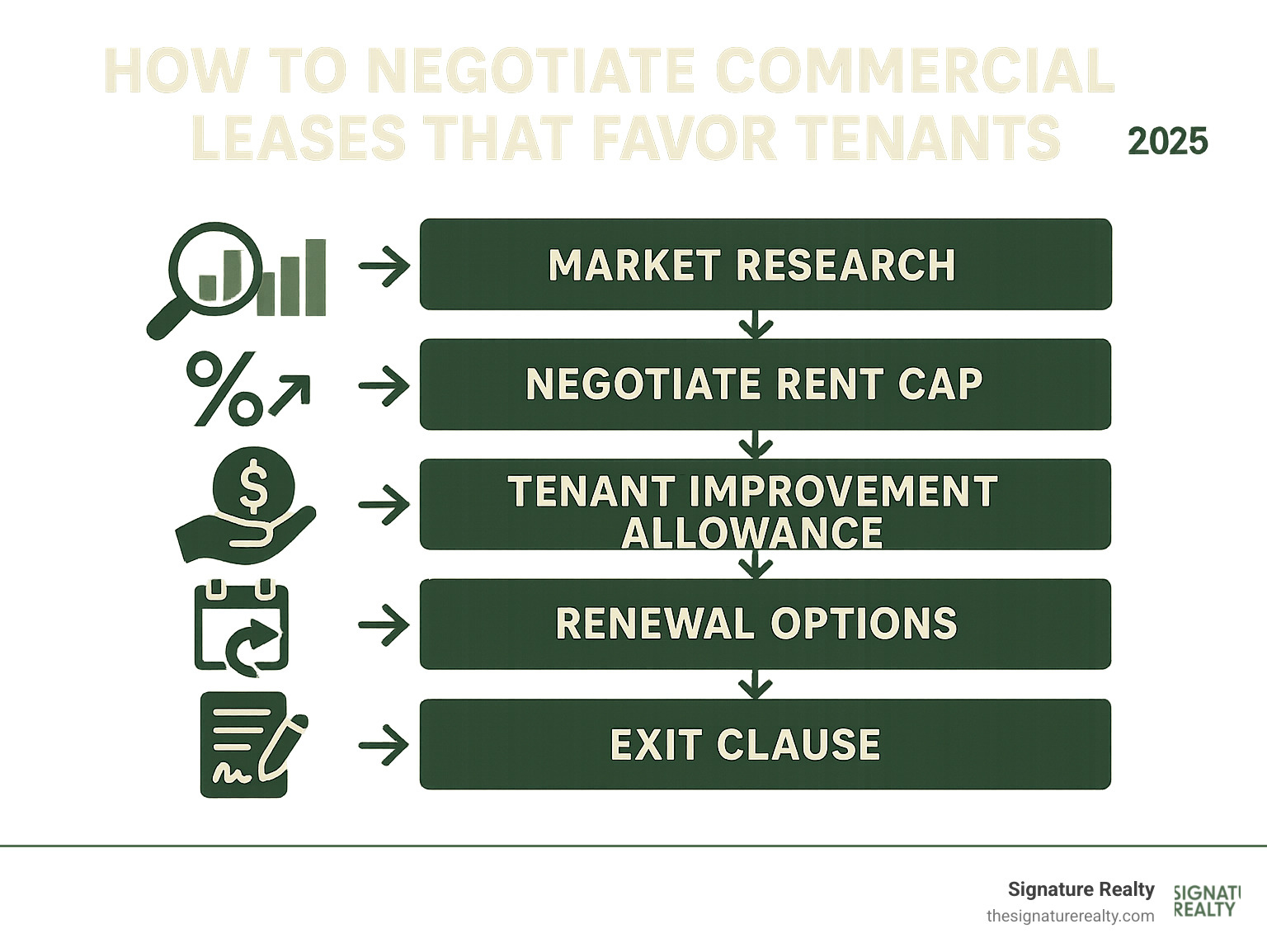
How to negotiate commercial leases that favor tenants requires preparation, market knowledge, and strategic leverage. The most successful tenants understand that nearly every lease term is negotiable, from rent escalation caps to tenant improvement allowances.
Quick Answer: Essential Tenant-Friendly Negotiation Tactics
- Research market rates – Know comparable rents before you negotiate
- Negotiate rent increase caps – Limit annual increases to 2-3% or CPI
- Secure tenant improvement allowances – Get $20-50 per square foot for build-outs
- Include early termination rights – Build in flexibility for business changes
- Cap operating expenses – Limit CAM charges and require audit rights
- Negotiate renewal options – Lock in predetermined rent increases
- Seek rent-free periods – Request 90-120 days for improvements and permits
For most companies, leases and operating costs are usually the second largest expense behind payroll. Yet many tenants accept landlord-friendly terms without understanding their negotiation power. The key is approaching discussions with preparation and professional guidance.
The stakes are high. During the COVID-19 pandemic, nearly half (47%) of companies paid full rent on unoccupied properties, while more than half planned to ask landlords for rent relief. This highlights why building flexibility into lease terms from the start is crucial.
I’m Brett Sherman, and I’ve helped negotiate over $200 million in commercial leases using AI-driven market analysis and strategic tenant representation. My experience shows that knowing how to negotiate commercial leases that favor tenants can save businesses 15-30% on occupancy costs while securing better terms and flexibility.
Common how to negotiate commercial leases that favor tenants vocab:
- commercial lease agreement florida
- negotiating a commercial lease buyout
- negotiating a commercial lease renewal
How to Negotiate Commercial Leases That Favor Tenants
The foundation of successful commercial lease negotiation lies in understanding that how to negotiate commercial leases that favor tenants starts with knowledge and preparation. Unlike residential leases, commercial leases assume both parties are equally sophisticated, even when a new business owner lacks negotiation experience.
Rule 1: The terms almost always favor the landlord. Rule 2: With a little effort, you can almost always negotiate significant improvements to the terms. This reality means tenants must actively negotiate detailed lease provisions beyond just base rent to secure terms that protect their business and control costs.
The most successful tenants approach negotiations with a cooperative mindset to foster win-win outcomes while maintaining the willingness to walk away if terms would disadvantage their business long-term. As one expert noted, “Negotiating without preparation is like setting sail without a map.”
For comprehensive guidance on commercial lease negotiations, Commercial Leases: Negotiate the Best Terms provides additional insights into the negotiation process.
Understanding Lease Structures to Negotiate Commercial Leases That Favor Tenants
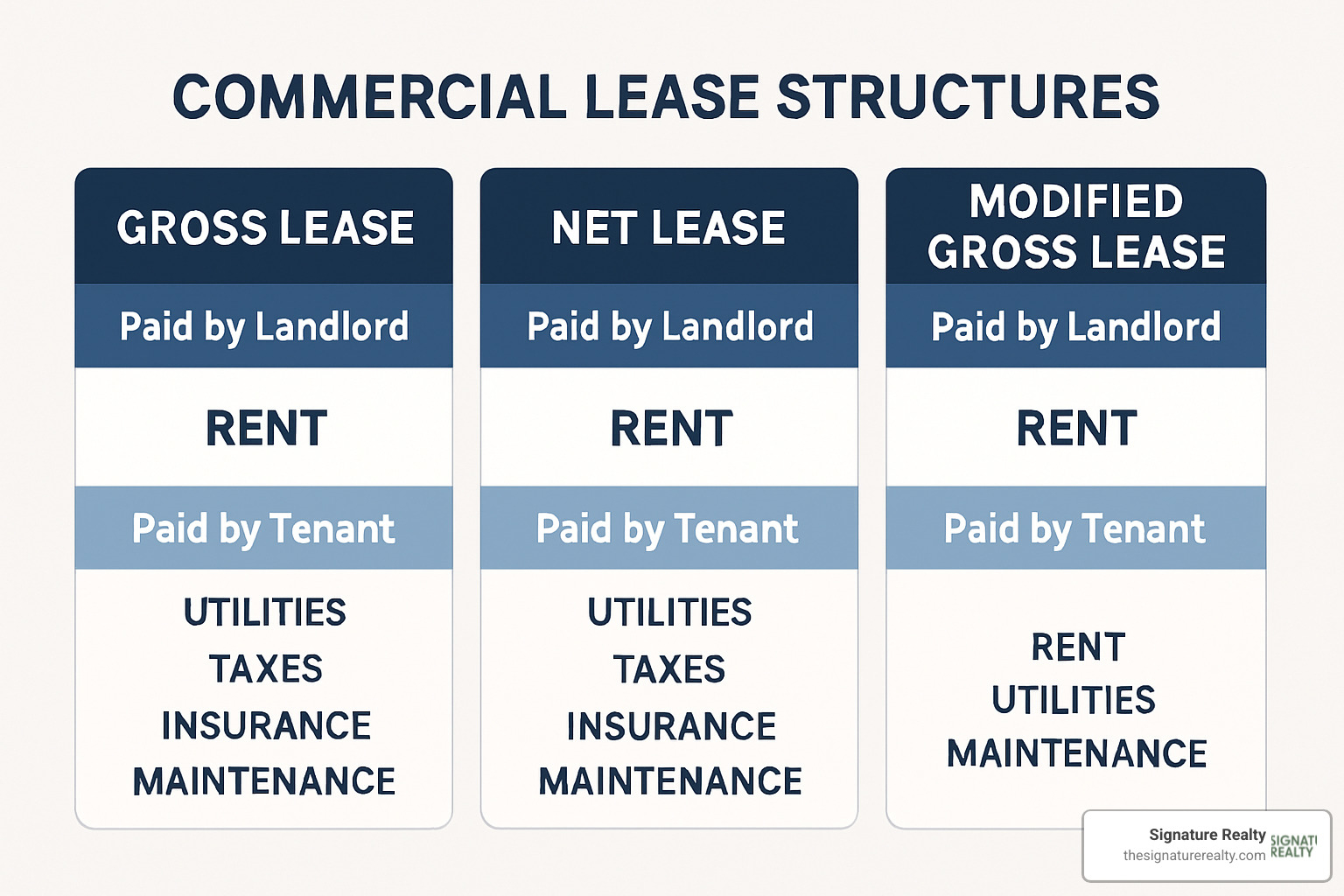
Commercial leases come in several structures, each shifting different responsibilities between landlord and tenant:
Gross Leases bundle rent and operating expenses into one flat monthly fee. The landlord pays for utilities, taxes, insurance, and maintenance. This structure provides predictable costs but landlords typically factor these expenses into higher base rent.
Net Leases separate base rent from operating costs:
- Single Net: Tenant pays property taxes plus base rent
- Double Net: Tenant pays property taxes and insurance plus base rent
- Triple Net (NNN): Tenant pays property taxes, insurance, and maintenance plus base rent
Modified Gross Leases split some costs between landlord and tenant, often with the landlord covering structural maintenance while tenants handle utilities and interior upkeep.
Percentage Leases tie a portion of rent to gross sales revenue, commonly used in retail. This structure aligns landlord and tenant incentives by motivating landlords to support tenant success.
When negotiating lease structure, consider trading a slightly higher base rent for the landlord to assume all maintenance and operating costs. This approach provides cost predictability and shifts the burden of unexpected expenses to the landlord.
Key Clauses to Target When You Negotiate Commercial Leases That Favor Tenants
Smart tenants focus on specific clauses that provide maximum protection and flexibility:
Rent Escalation Caps: Negotiate caps on annual rent increases, typically 2-3% or tied to the Consumer Price Index (CPI). Try to exclude rent increases for the first year. Some tenants successfully tie rent increases to their revenue stream, sharing upside with the landlord while protecting against disproportionate cost increases.
Tenant Improvement Allowances (TIA): Secure $20-50 per square foot for build-out expenses. Clarify what’s included (flooring, lighting, HVAC) and excluded from the allowance. Negotiate control over timelines and fund disbursement to avoid delays.
Common Area Maintenance (CAM) Caps: Many commercial leases include extra fees that can easily be avoided through upfront negotiation. Require landlords to calculate CAM charges reasonably and consistently with industry standards. Include absolute caps and audit rights with a two-year lookback period.
Capital Expenditure Treatment: Require landlords to depreciate capital expenses over IRS-compliant schedules (typically 10+ years) rather than passing them through as lump-sum CAM charges. This prevents surprise expenses like a $20,000 elevator repair being charged in a single year.
Maintenance Responsibilities: Clearly define routine versus structural maintenance obligations. Negotiate warranty periods of 90-120 days on HVAC and major systems. Try to shift major repair costs back to the landlord or negotiate shared expenses with caps.
Early Termination Rights: Include specific conditions allowing early lease termination – landlord defaults, business failure, expansion needs, or negative property changes. Negotiate reasonable termination fees rather than full lease liability.
Subleasing and Assignment Rights: Secure explicit rights to sublease or assign the lease. This provides crucial flexibility if your business needs change. Negotiate reasonable landlord approval standards that can’t be unreasonably withheld.
For more detailed guidance on securing rent-free periods, check out our guide on How to Negotiate Free Rent for a Commercial Lease.
Leveraging Market Data & Professional Help

Successful lease negotiation requires understanding current market conditions and leveraging professional expertise:
Market Intelligence Sources:
- Local brokerage market reports
- CoStar or LoopNet commercial databases
- Recent comparable lease transactions
- Vacancy rates and absorption data
- Economic indicators affecting your industry
Professional Support Team:
- Tenant Representation Brokers: Provide market context and negotiation expertise while representing your interests exclusively
- Commercial Real Estate Attorneys: Review lease language, identify risks, and ensure enforceability of negotiated terms
- Lease Accounting Software: Centralize lease data, track critical dates, and identify cost-saving opportunities
At Signature Realty, we use proprietary AI deal analysis to streamline lease negotiations while maximizing outcomes for our clients. Our data-driven approach has saved clients over $2 million in lease negotiations by identifying market opportunities and negotiation leverage points.
Key Market Factors Affecting Negotiation Power:
- Time remaining on your current lease
- Local vacancy rates and market conditions
- Size and desirability of your space requirements
- Landlord’s motivation to fill vacant space
- Economic conditions affecting your industry
Understanding whether you’re in a landlord’s market or tenant’s market significantly impacts your negotiation strategy and leverage. For comprehensive negotiation support, explore our Commercial Lease Negotiation Services.
Putting It All Together: Your Tenant-Friendly Negotiation Playbook
The key to successful commercial lease negotiation is systematic preparation and strategic execution. Your negotiation power comes from preparation, market knowledge, and the willingness to walk away if terms don’t serve your business interests.
Building Leverage Through Preparation:
- Evaluate multiple properties simultaneously to create competition
- Prepare detailed financial statements demonstrating business stability
- Research comparable properties and recent lease transactions
- Identify your non-negotiable requirements versus nice-to-have features
- Develop a maximum budget including all occupancy costs
Strategic Negotiation Approach:
- Address all key terms before agreeing on rent to maximize leverage
- Request rent-free periods of 90-120 days for tenant improvements and permits
- Negotiate specific renewal options with predetermined rent escalations
- Include mutual confidentiality provisions to protect sensitive business information
- Secure right of first refusal on adjacent space for future expansion
Landlords often provide two to three months rent-free as an inducement to rent commercial space, especially if the space has been vacant. A short-term lease is almost always beneficial for tenants, providing flexibility if business needs change.
7-Step Timeline from LOI to Move-In
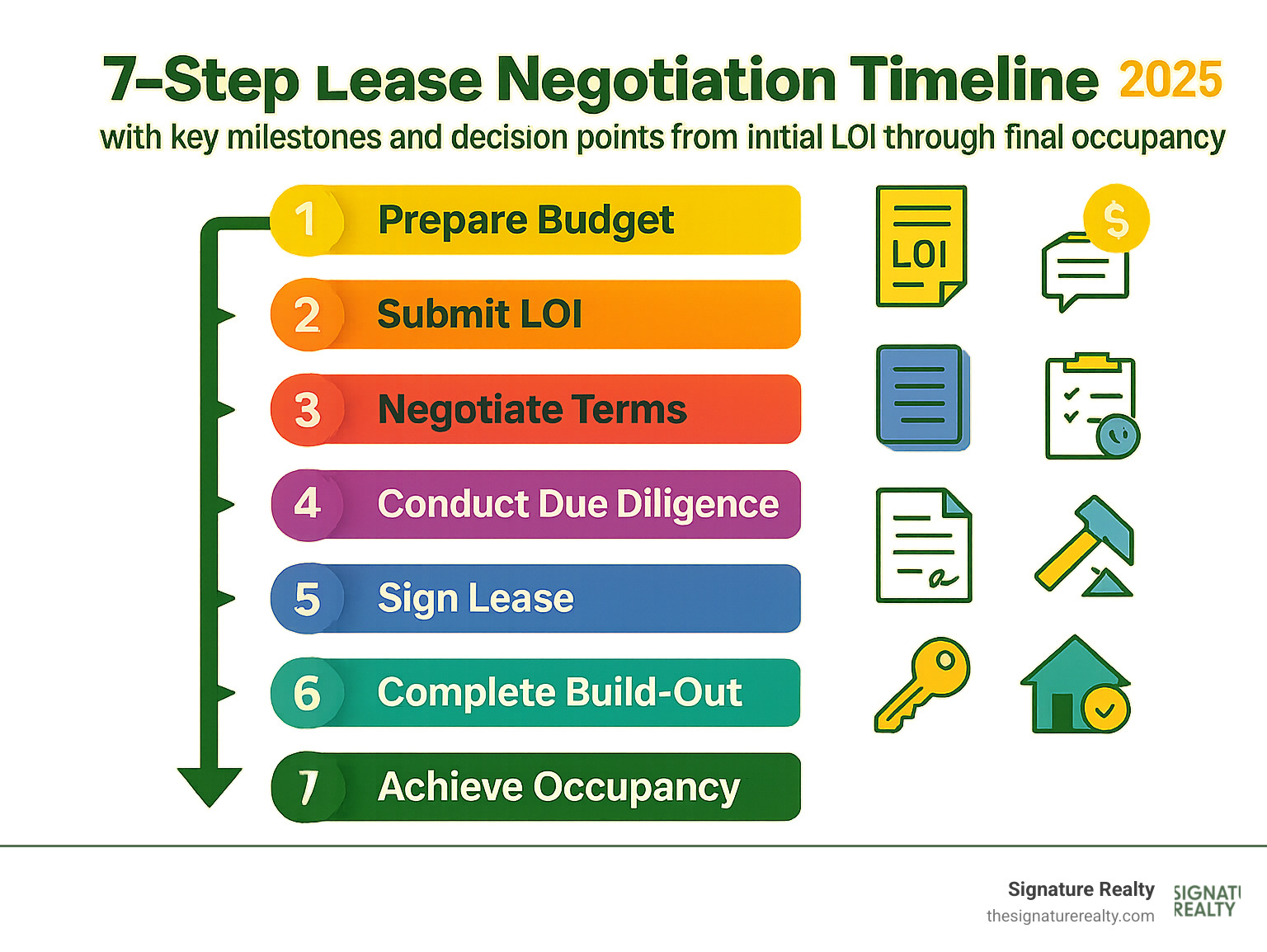
Step 1: Prepare Your Budget (Week 1)
- Calculate total occupancy costs including base rent, CAM charges, utilities, and improvements
- Determine maximum affordable rent and operating expense caps
- Gather financial statements and credit reports to demonstrate stability
Step 2: Draft Letter of Intent (Week 2)
- Outline key terms including rent, escalations, lease term, and renewal options
- Include preliminary tenant improvement allowance and rent-free period requests
- Specify major deal points like early termination rights and sublease permissions
Step 3: Negotiate Core Terms (Weeks 3-4)
- Focus on rent structure, escalation caps, and operating expense limitations
- Negotiate tenant improvement allowances and build-out timelines
- Secure favorable maintenance responsibilities and capital improvement allocations
Step 4: Legal Review (Week 5)
- Engage a commercial real estate attorney to review lease language
- Identify and address potential risks or ambiguous terms
- Ensure all negotiated terms are properly documented and enforceable
Step 5: Final Walkthrough (Week 6)
- Inspect property condition and verify all systems are operational
- Document any needed repairs or improvements before occupancy
- Confirm compliance with zoning requirements and building codes
Step 6: Obtain Occupancy Permits (Week 7)
- Secure necessary business licenses and permits
- Coordinate utility connections and service transfers
- Finalize insurance coverage meeting lease requirements
Step 7: Post-Move Audit (Week 8)
- Verify all lease terms are being implemented correctly
- Set up systems to track CAM charges and operating expenses
- Establish procedures for exercising renewal options and other lease rights
For guidance on lease renewals, reference our comprehensive article on Negotiating a Commercial Lease Renewal. When you’re ready to exercise renewal options, you can find helpful resources at Notice of Exercise of Commercial Lease Option.
Common Pitfalls & How to Avoid Them

Hidden Fees and Costs
Many commercial leases include additional fees that can significantly impact your total occupancy cost. Common hidden fees include signage charges, extra keys, parking fees, and administrative costs. Negotiate these items upfront or request they be included in base rent.
Unclear Use Restrictions
Ensure permitted use clauses are broad enough to accommodate business pivots or expansions. Narrow use restrictions can prevent you from adapting to market changes or expanding your service offerings.
Inadequate Cure Periods
Negotiate minimum 30-day cure periods for lease violations and at least 5-day grace periods for rent payments. Avoid “immediate default” clauses that provide no opportunity to remedy minor violations.
Personal Guarantee Exposure
Limit personal guarantees to the first year or two of the lease term rather than the entire lease period. This caps your personal liability while providing the landlord initial security.
Unbalanced CAM Charges
Require landlords to warrant that CAM calculations are reasonable and consistent with industry standards. Include audit rights and caps to prevent excessive or unexpected charges.
Outdated HVAC and Systems
Inspect all mechanical systems before signing and negotiate responsibility for major repairs or replacements. Include warranty periods and consider caps on your share of system upgrade costs.
Inadequate Pandemic Clauses
Include specific force majeure language covering pandemics, government-mandated closures, and health emergencies. Negotiate rent abatement or deferral rights during involuntary business interruptions.
Signature Realty Advantage & Next Steps
At Signature Realty, we’ve spent over 13 years perfecting the art of tenant-friendly lease negotiations in the Miami market. Our exclusive focus on tenant representation means we never have conflicts of interest – we work solely for you.
Our Proven Track Record:
- Over $2 million saved for clients through strategic lease negotiations
- Access to exclusive off-market deals not available to the general public
- Proprietary AI deal analyzer that identifies optimal negotiation strategies
- Deep Miami market knowledge covering Doral, Hialeah, and Medley submarkets
Our Data-Driven Approach:
We leverage advanced analytics to identify market opportunities and negotiation leverage points. Our AI deal analyzer evaluates lease terms against market standards, highlighting areas where you can secure better terms or avoid unfavorable clauses.
What Sets Us Apart:
- Exclusive tenant representation – we never represent landlords
- Comprehensive market intelligence and comparable analysis
- Strategic negotiation planning custom to your business needs
- Post-lease support including CAM audits and renewal negotiations
The commercial lease negotiation process can be complex, but with the right preparation, market knowledge, and professional support, you can secure terms that support your business success while controlling costs.
Ready to start your tenant-friendly lease negotiation? Our team at Signature Realty is here to help you steer the process and secure the best possible terms for your business. Learn more about our comprehensive Tenant Representation Services and find how we can help you win at commercial lease negotiations.
Take Action Today: Contact Signature Realty to schedule your consultation and learn how our proven negotiation strategies can save you money while securing better lease terms. With our expertise and your business goals, we’ll create a lease agreement that truly serves your interests.