
The Developer Guide to Miami Zoning Regulations
Why Mixed Use Zoning Miami Regulations Matter for Developers and Tenants
Mixed use zoning Miami governs how buildings and land can combine residential, retail, office, and industrial uses in a single project or block. If you need a quick answer, here’s how it works:
Quick Reference: Miami Mixed Use Zoning at a Glance
| What You Need to Know | Key Detail |
|---|---|
| Governing code | Miami 21 (form-based, adopted 2010) |
| Primary mixed-use transect zones | T5 Urban Center, T6 Urban Core |
| Maximum density (TSND Enhanced) | Up to 500 units/acre near rail stations |
| Live Local Act max density | Up to 1,000 units/acre (40% income-restricted) |
| How to check your property | Miami GIS Zoning Tool |
| Approval paths | By right, Warrant, or Exception (PZAB hearing) |
| Key affordable housing trigger | TSND requires 3–10% affordable units depending on tier |
Miami’s zoning rules are layered. You have the city’s Miami 21 code, Miami-Dade County overlays, and state-level legislation like the Live Local Act — all stacked on top of each other. Miss one layer and you’re looking at costly delays or redesigns.
This guide cuts through that complexity. Whether you’re a retailer scouting space in Doral, a developer eyeing a transit corridor in Hialeah, or an industrial contractor in Medley looking at flex warehouse conversions — understanding how these rules interact is the difference between a smooth approval and a prolonged fight with the planning board.
I’m Brett Sherman, a commercial real estate advisor with hands-on experience navigating mixed use zoning miami regulations across South Florida markets including Doral, Hialeah, and Medley. I’ve helped tenants and developers decode Miami 21 transect zones, structure lease terms around zoning constraints, and identify off-market mixed-use opportunities using AI-driven market data. Let’s break down exactly how this system works — and how to use it to your advantage.
Navigating Mixed Use Zoning Miami: The Miami 21 Framework
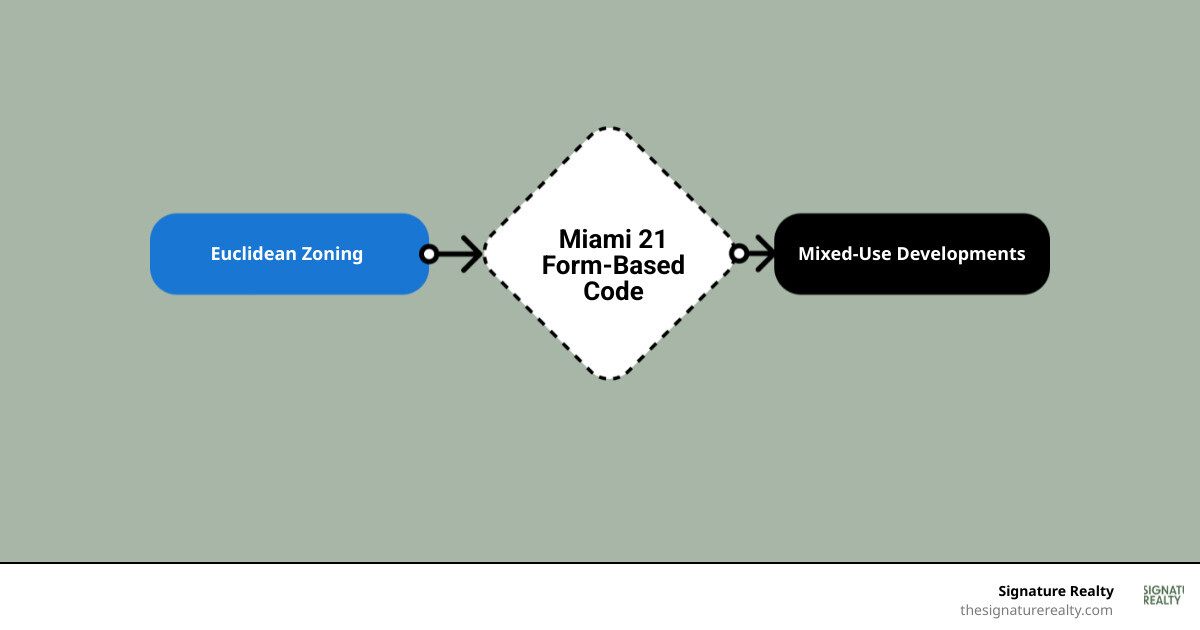
When we talk about mixed use zoning miami, we are primarily talking about Miami 21. Adopted in 2010, this was a shift from “Euclidean” zoning (which separates uses like oil and water) to a “form-based” code. Instead of just telling you what you can build, Miami 21 focuses on how the building looks and interacts with the street.
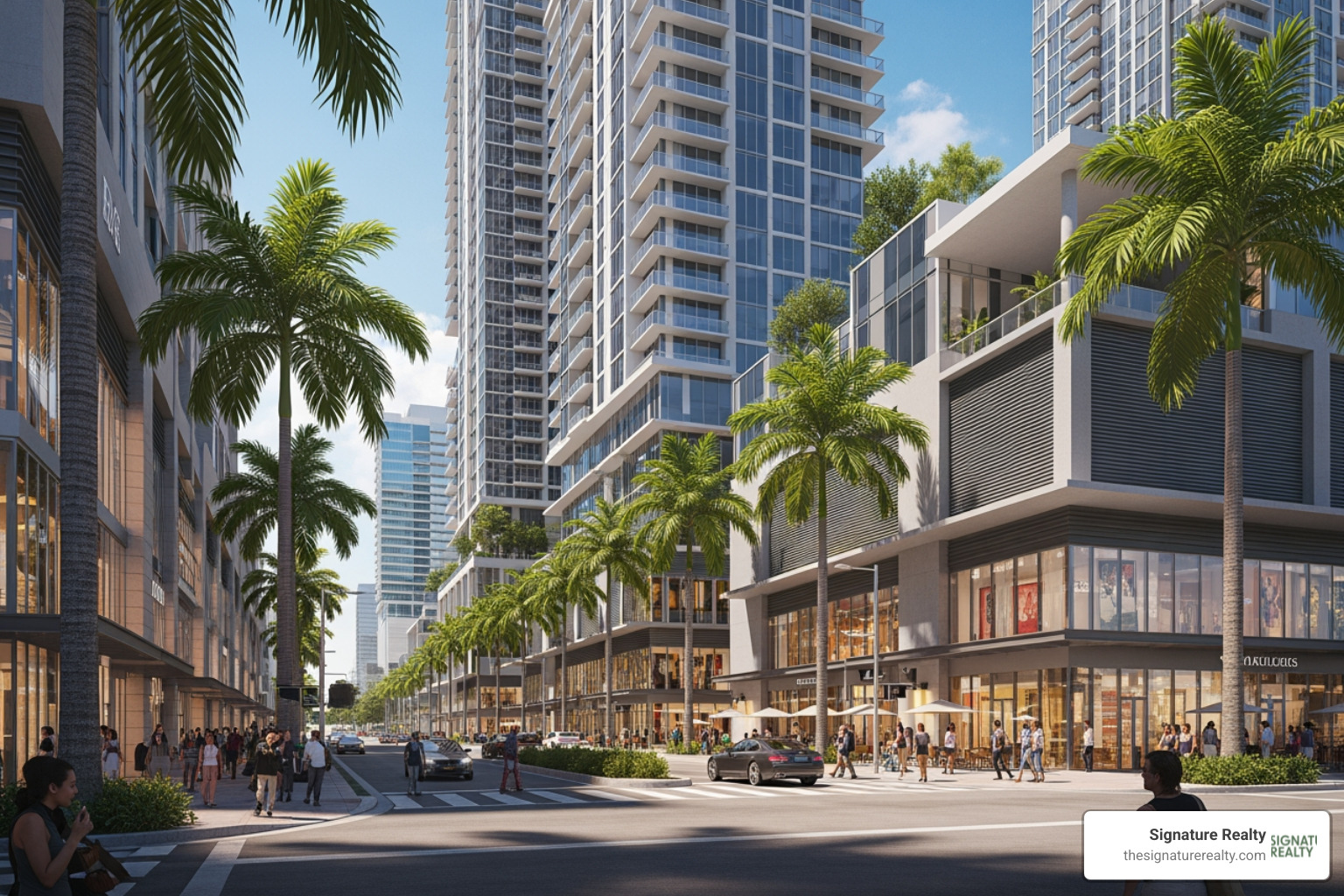
The “Transect” is the heart of this system. It organizes the city into zones ranging from T1 (Natural) to T6 (Urban Core). For most mixed-use developers, the action happens in T5 and T6. These zones encourage a “live-work-play” environment by allowing retail on the ground floor, offices in the middle, and residential units on top. This is the gold standard for investment property Miami because it diversifies income streams for the owner while providing built-in customers for the ground-floor retail tenants.
To see exactly what a parcel allows, you should View the Miami 21 Code Search Property. It provides the specific “Transect Zone” for every lot in the city.
Comparison of Primary Mixed-Use Transect Zones
| Feature | T5 Urban Center | T6 Urban Core |
|---|---|---|
| Character | Main street feel, walkable | High-density, skyscraper potential |
| Max Height | Up to 12 stories (T5-O) | 24 to 80+ stories (T6-80) |
| Floor Lot Ratio (FLR) | Typically 3.0 to 5.0 | 11.0 to 18.0+ |
| Typical Uses | Retail, Office, Residential | Hotel, Retail, Office, Luxury Condo |
Understanding Mixed Use Zoning Miami Classifications
Within the broader world of South Florida, you’ll encounter various shorthand terms for mixed-use districts. While Miami 21 uses Transects, other municipalities and older county codes use classifications like MU-1, MU-2, and MU-3:
- MU-1 (Low Intensity): Typically allows 3–5 stories. This is common in residential-adjacent areas where you want a local coffee shop or small professional office without the shadow of a skyscraper.
- MU-2 (Medium Intensity): Allows 10+ stories and higher residential density. This is the “sweet spot” for many mid-market multifamily projects.
- MU-3 (High Intensity): Reserved for urban cores like Downtown. Think 20+ stories, high-end hotels, and maximum density.
The distinction between vertical and horizontal integration is also vital. Vertical integration means stacking uses within one building (e.g., a condo tower over a Whole Foods). Horizontal integration means placing different uses side-by-side on the same block (e.g., an office building next to a park and a row of townhomes).
In high-value areas like Miami, Doral, and Medley, vertical integration is often the only way to make the numbers work given the high cost of land. However, horizontal layouts are gaining traction in suburban hubs where “lifestyle centers” are replacing traditional malls.
Transit-Oriented Development and TSND Legislation
One of the biggest shifts in mixed use zoning miami recently is the push for Transit-Oriented Development (TOD). The city and county want people out of their cars and onto the Metrorail and Metromover. To make this happen, they’ve introduced “3D Zoning” — a layer-cake of incentives.
The Transit Station Neighborhood Districts (TSND) legislation is a game-changer. It creates TOD Nodes within a half-mile of rail stations. If your property qualifies, the density limits effectively vanish.
- General TSND: Allows up to 12–20 stories.
- Enhanced TSND: Can push heights to 24 stories or more.
The trade-off? You must provide public benefits. This usually includes transit-oriented development in Miami improvements, open spaces, or affordable housing. For an Enhanced TSND, developers are often required to set aside a percentage of units for residents earning 60%, 100%, and 120% of the Area Median Income (AMI).
We also have the Rapid Transit Zone (RTZ), a county-level overlay that streamlines approvals for projects near transit. By bypassing some of the slower city-level hearings, developers can get to “shovels in the ground” much faster.
Impact of the Live Local Act on Mixed Use Zoning Miami
You cannot discuss mixed use zoning miami today without mentioning the Live Local Act. This Florida state law effectively preempts local zoning in a way we’ve never seen before.
If a project is located in a commercial, industrial, or mixed-use zone and sets aside at least 40% of its units for “workforce housing” (households earning up to 120% AMI) for 30 years, the developer gets massive “bonuses”:
- Density: You can build at the highest density allowed anywhere in the city (up to 1,000 units/acre in some Miami spots).
- Height: You can build as high as any building within one mile of your site.
- Administrative Review: The city cannot force you through a public hearing if you meet the requirements. This removes the “NIMBY” (Not In My Backyard) risk from the equation.
For our clients in Hialeah, Doral, and Medley, this has opened up parcels that were previously restricted to low-rise warehouses. Now, those same lots can support high-density residential towers, helping to ease the Florida housing boom and the resulting supply shortage.
Strategic Implementation in South Florida Hubs
While Miami’s urban core gets the headlines, we are seeing incredible mixed-use activity in Doral, Hialeah, and Medley. These areas are shifting from pure industrial/commercial hubs into vibrant communities.
- Doral: Known for its massive business parks, Doral has mastered the “lifestyle” mixed-use model. Projects like CityPlace Doral combine luxury apartments with high-end retail and entertainment.
- Hialeah: The “City of Progress” is seeing a wave of adaptive reuse. Old garment factories and warehouses are being repurposed into creative lofts and micro-retail spaces. If you’re looking at property here, the Zoning and Land Use Mobile Map – City of Hialeah is your first stop to see what’s possible.
- Medley: While still heavily industrial, Medley is seeing “flex” mixed-use. This involves “Industrial-Commercial” blends where a company has its warehouse, showroom, and corporate office all in one footprint.
Application Process: Warrants, Exceptions, and GIS Tools
Navigating the approval process for mixed use zoning miami is a bit like playing chess. You need to know which moves are allowed “by right” and which require a permit.
- Check the GIS Tool: Start by entering your address into the GIS Map Tool. Search for your “Transect Zone.”
- The “R, W, E” Table: Look at the Miami 21 Use Table.
- R (By Right): You can build it as long as you follow the building codes.
- W (Warrant): This is an administrative permit. The Planning Director reviews it to ensure it fits the neighborhood.
- E (Exception): This requires a public hearing before the Planning, Zoning, and Appeals Board (PZAB). This is where community concerns about traffic and shadows come into play.
- Documentation: You’ll need site plans, building elevations, floor plans, and often a traffic impact study.
For larger projects, you might need a Unity-of-Title, which legally binds multiple smaller lots into one “building site” for zoning purposes. This is common in commercial land development Miami where developers assemble several older parcels to create a footprint large enough for a modern tower.
Case Studies: Miami Worldcenter and Wynwood
Two neighborhoods perfectly illustrate the power of strategic mixed-use planning:
Miami Worldcenter: This is one of the largest private master-planned projects in the U.S. It uses a specific “Appendix D” zoning overlay that supersedes parts of Miami 21.
- Density: It allows a Floor Lot Ratio (FLR) of 18, which can be boosted to 27 via public benefit bonuses.
- Sustainability: All buildings must be at least LEED Silver certified.
- Pedestrian Focus: It mandates wide sidewalks and “Liner Buildings” to hide ugly parking garages from view.
Wynwood: Once a derelict warehouse district, Wynwood’s NRD-1 (Neighborhood Revitalization District) overlay encouraged Wynwood commercial real estate growth by allowing residential uses in what was previously a strictly industrial zone. It prioritized the preservation of street art and the “industrial feel” while allowing for new, high-density office and residential “creative” spaces.
Conclusion: Maximizing ROI with Signature Realty
The complexity of mixed use zoning miami is exactly why you shouldn’t go it alone. Whether you are a tenant looking for a retail spot that won’t get shut down by code enforcement, or a developer trying to maximize your FLR, the stakes are high.
At Signature Realty, we specialize in more than just finding buildings; we find opportunities. With over 13 years of experience in the Miami, Doral, Hialeah, and Medley markets, we’ve seen how zoning can make or break a deal. Our proprietary AI deal analyzer allows us to scan thousands of data points to identify the best “by right” opportunities or properties primed for a Live Local Act play.
We pride ourselves on our data-driven strategies that have saved our clients over $2 million in lease negotiations. By understanding the underlying zoning, we can negotiate better terms — because we know exactly what the landlord is allowed to do (and what they aren’t).
If you’re ready to navigate mixed-use commercial zoning in Miami, let us put our expertise and exclusive off-market deals to work for you. Reach out to us today to see how we can streamline your next project and maximize your return on investment in Miami, Doral, Hialeah, and Medley.