
How to Lease a Strip Center Without Losing Your Mind
What You Need to Know About Strip Center Leasing (Before You Sign Anything)
Strip center leasing is the process of renting retail, restaurant, or service space inside an open-air shopping center — typically a row of storefronts sharing a parking lot, without an enclosed mall structure.
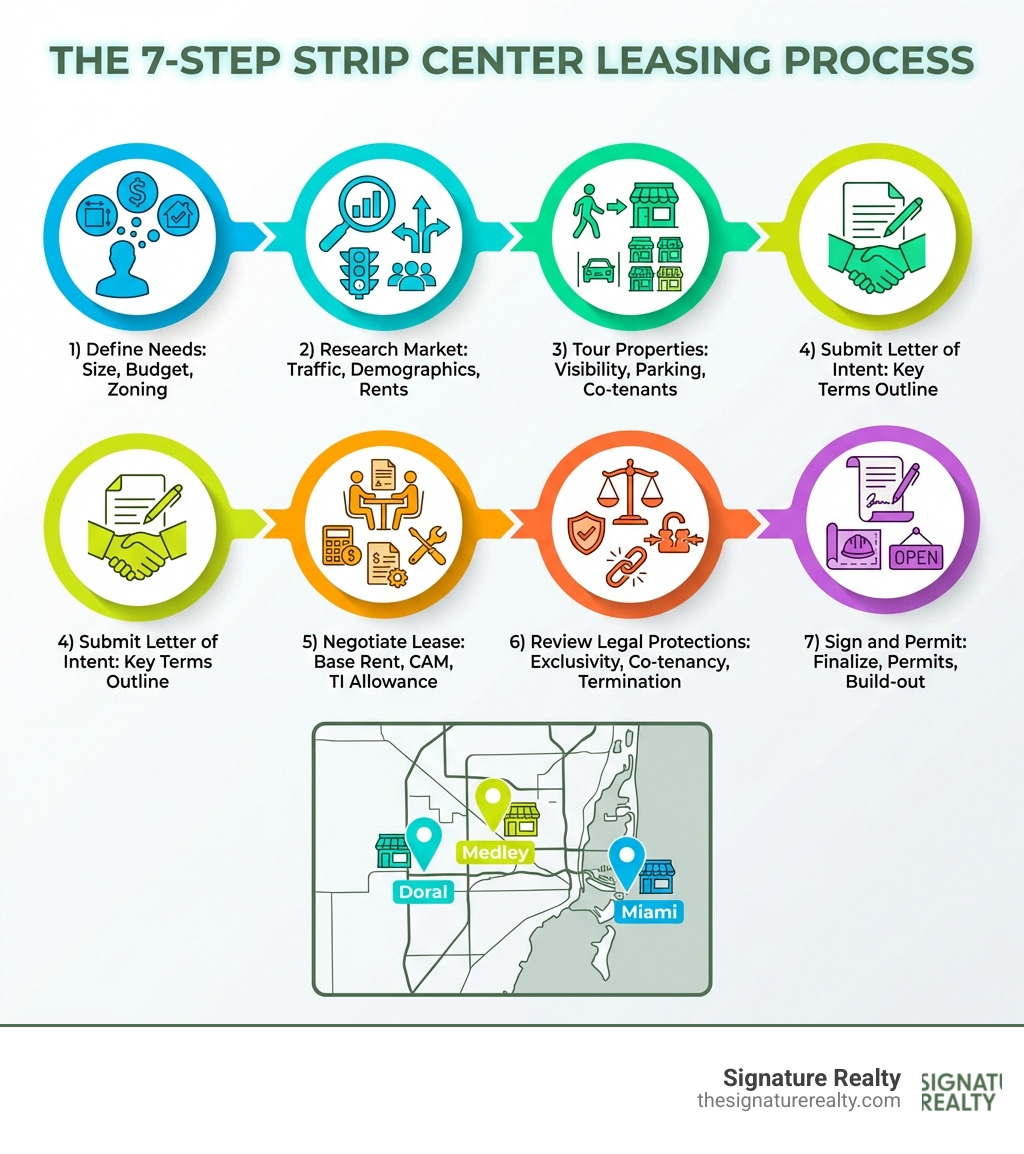
Here’s a quick overview of what the process looks like:
| Step | What Happens |
|---|---|
| 1. Define your needs | Size, budget, location, and required zoning |
| 2. Research the market | Traffic counts, demographics, comparable rents |
| 3. Tour properties | Evaluate visibility, parking, co-tenants |
| 4. Submit a Letter of Intent | Outline key terms before the full lease |
| 5. Negotiate the lease | Base rent, CAM charges, TI allowance, clauses |
| 6. Review legal protections | Exclusivity, co-tenancy, termination rights |
| 7. Sign and permit | Finalize lease, pull permits, begin build-out |
Strip centers are one of the most common retail formats in South Florida. In markets like Miami, Doral, and Hialeah, they line major corridors — from Doral’s corporate-heavy Flagler Street to busy US-1 in Miami-Dade. Demand is strong: occupancy rates across strip center markets are above 95%, and rents are rising fast.
But leasing one of these spaces isn’t simple. Hidden escalation clauses, CAM charges, zoning requirements, and co-tenancy traps catch many tenants off guard — especially first-timers or growing businesses trying to move fast without missing the right location.
This guide walks you through every step, in plain language.
I’m Brett Sherman, and my background in strip center leasing includes hands-on deal negotiations across South Florida markets — using AI-driven lease benchmarking to help tenants avoid costly mistakes and lock in terms that actually support long-term growth. Throughout this guide, I’ll share the same frameworks and insights I use with clients every day.
Navigating the Essentials of Strip Center Leasing
When we talk about retail-strip-center opportunities, we aren’t just talking about a roof and four walls. We are talking about a strategic ecosystem. Unlike massive enclosed malls where shoppers might wander for hours, strip centers thrive on “convenience.” People pull in, get what they need, and pull out. This makes factors like ease of entry and parking density much more critical than they would be in a traditional mall.
In Doral, for example, a storefront needs to be accessible for the lunch-break rush of corporate employees. In Hialeah, it needs to be positioned where local residents can stop on their way home from work. Understanding these nuances is the first step to ensuring your business doesn’t just exist, but thrives.
Understanding Costs and Lease Structures in Strip Center Leasing
The most common phrase you will hear in strip center leasing is “Triple Net” or NNN. If you’re coming from residential renting, this can be a bit of a shock. In an NNN lease, the “base rent” is just the beginning. You are also responsible for your pro-rata share of the building’s operating expenses: property taxes, insurance, and Common Area Maintenance (CAM).
CAM charges cover everything from the guy who sweeps the parking lot to the electricity for the pylon sign. In Miami-Dade, these costs can fluctuate, so it’s vital to have a retail-lease-negotiation-ultimate-guide to help you cap these increases.
| Lease Type | Base Rent | Taxes/Insurance/CAM | Utilities |
|---|---|---|---|
| Triple Net (NNN) | Lower | Paid by Tenant | Paid by Tenant |
| Modified Gross | Mid-range | Shared/Negotiated | Usually Tenant |
| Full Service | Higher | Included in Rent | Included |
Another factor to watch for is percentage rent. This is common in high-traffic centers where the landlord wants a piece of your success. Typically, once your sales hit a “natural breakpoint” (the point where a percentage of your sales equals your base rent), you start paying a small percentage of every dollar earned beyond that to the landlord. While it sounds daunting, it can sometimes be negotiated in exchange for a lower base rent.
Key Factors for Success: Visibility, Traffic, and Co-Tenancy
In retail-tenant-rep, we often say that visibility is your cheapest form of marketing. If 40,000 cars drive past your sign on US-1 every day, that’s 40,000 “impressions” you didn’t have to pay Google or Meta for.
However, traffic counts aren’t everything. You need to look at who is in those cars. In Medley, the traffic might be heavy with industrial trucks and commuters, making it a prime spot for a quick-service restaurant or a hardware supplier, but perhaps less ideal for a high-end boutique.
Co-tenancy is the secret sauce of strip center leasing. If you are a nail salon, being next to a busy grocery store or a Starbucks is gold. Those “anchor” tenants pull people into the center, and you get the “halo effect” of their foot traffic. On the flip side, you want to ensure your lease prevents the landlord from putting a direct competitor right next door.
Legal Safeguards and Clauses in Strip Center Leasing
Retail leases are significantly more complex than office or industrial leases. You need specific “teeth” in your contract to protect your business. According to Retail Leases: Getting Started – A Brief Primer, there are four non-negotiables you should address in your Letter of Intent:
- Exclusive Use: This prevents the landlord from leasing space to a direct competitor. If you sell pizza, you don’t want another pizza shop opening three doors down.
- Co-tenancy Requirements: This clause allows you to pay reduced rent or even terminate your lease if the “anchor” tenant (like a Publix or Target) leaves the center and isn’t replaced within a certain timeframe. If the big draw goes away, your foot traffic dies, and your rent should reflect that.
- Radius Restrictions: Landlords often try to prevent you from opening another location within a 3-5 mile radius, fearing you’ll “cannibalize” the sales of the current location. In a dense market like Miami or Hialeah, this can be a major growth killer. We fight to keep these as narrow as possible.
- Signage Rights: Don’t assume you can just hang a sign. You need to check the retail-survey and local zoning laws. Municipalities like Doral have very specific rules about sign height, illumination, and colors.
Mastering the South Florida Retail Market
The South Florida market is a beast of its own. Between the diverse demographics of Hialeah and the logistics-heavy landscape of Medley, a “one-size-fits-all” approach to leasing will fail. We’ve seen average retail rents in the Miami area hit significant highs, with some prime spots in Doral commanding $35-$60 per square foot.
To find the best deals, you often have to look beyond the public listings on LoopNet or CoStar. Many of the best property-types/retail opportunities are “off-market” deals held by landlords who prefer to work with trusted brokers rather than listing publicly.
Evaluating Locations in Miami, Doral, and Hialeah
When we evaluate retail-space-for-rent-miami-fl, we look at three main data points:
- Daytime Population: Crucial for lunch-heavy businesses (Doral/Medley).
- Household Income: Critical for service and luxury retail (Miami/Coral Gables).
- Parking Ratios: In Miami, parking is at a premium. If your business requires customers to stay for an hour (like a gym or restaurant), you need a higher parking ratio than a dry cleaner.
Zoning is another hurdle. Just because a space was a clothing store doesn’t mean it can become a cafe. Restaurants require grease traps, specific venting, and often higher parking counts. Before you sign, we always recommend a “zoning verification” to ensure your “Use” is actually permitted. If you’re looking at nearby markets, our fort-lauderdale-retail-market-guide offers a great comparison of how different South Florida municipalities handle these permits.
Short-Term Opportunities and Pop-Up Strategies
Not every lease needs to be a 10-year commitment. We are seeing a massive rise in “specialty leasing” in South Florida. This includes:
- Pop-up Shops: Perfect for testing a brand in a new neighborhood like Hialeah before committing long-term.
- RMUs and Kiosks: Retail Merchandising Units are those small carts you see in the common areas. They offer high visibility with low overhead.
- Seasonal Leases: Ideal for businesses that thrive during the holidays or the “snowbird” season.
If you are looking for retail-rental-space-near-me or trying to lease-retail-space-near-me, short-term options can be a great way to “test drive” a center’s traffic before signing a permanent deal.
Conclusion: Partnering for Profitable Retail Placements
Leasing a strip center space is one of the biggest financial commitments your business will ever make. You shouldn’t do it based on a “gut feeling” or a pretty storefront. You need data, legal protection, and a negotiator who knows the local landlords.
At Signature Realty, we’ve spent over 13 years mastering the Miami, Doral, Hialeah, and Medley markets. We don’t just find you a space; we use our proprietary AI deal analyzer to benchmark your lease against every other deal in the area. This data-driven approach has saved our clients over $2 million in lease negotiations to date.
Whether you are looking for an off-market retail-strip-center in Miami or a high-traffic end-cap in Doral, we are here to ensure you get the best terms possible without losing your mind in the process.
Ready to find your next location? Let’s talk about how we can protect your bottom line and set your business up for success in South Florida.