
Why Smart Business Owners Never Sign Their First Lease Offer
A guide to negotiating leases for commercial properties can mean the difference between business success and financial disaster. Yet research shows that 68% of entrepreneurs sign commercial leases without professional legal review, often missing critical negotiation opportunities that could save thousands of dollars.
Quick Commercial Lease Negotiation Essentials:
- Research market rates – Know comparable properties in Miami, Doral, Hialeah, and Medley
- Understand lease types – Gross, Net, and Triple Net (NNN) have different cost structures
- Negotiate key terms – Base rent, CAM charges, renewal options, and tenant improvements
- Secure professional help – Use tenant representation and legal counsel
- Plan exit strategies – Include termination clauses and subletting rights
- Cap variable costs – Limit annual rent increases and operating expense pass-throughs
Commercial leases in South Florida’s competitive market aren’t just contracts – they’re strategic business decisions that impact your bottom line for years. Whether you’re expanding your retail operation in Doral or securing warehouse space in Medley, the stakes are high.
The old saying “location is everything in real estate” rings especially true for commercial properties. But how you negotiate your lease terms can be just as important as where you locate your business.
I’m Brett Sherman, and I’ve helped countless South Florida businesses steer complex lease negotiations using AI-driven market analysis and targeted negotiation strategies. My experience creating virtual lease audits and negotiating tenant-favorable terms like rent caps and improvement allowances has consistently delivered a guide to negotiating leases for commercial properties that protects business interests while securing prime locations.
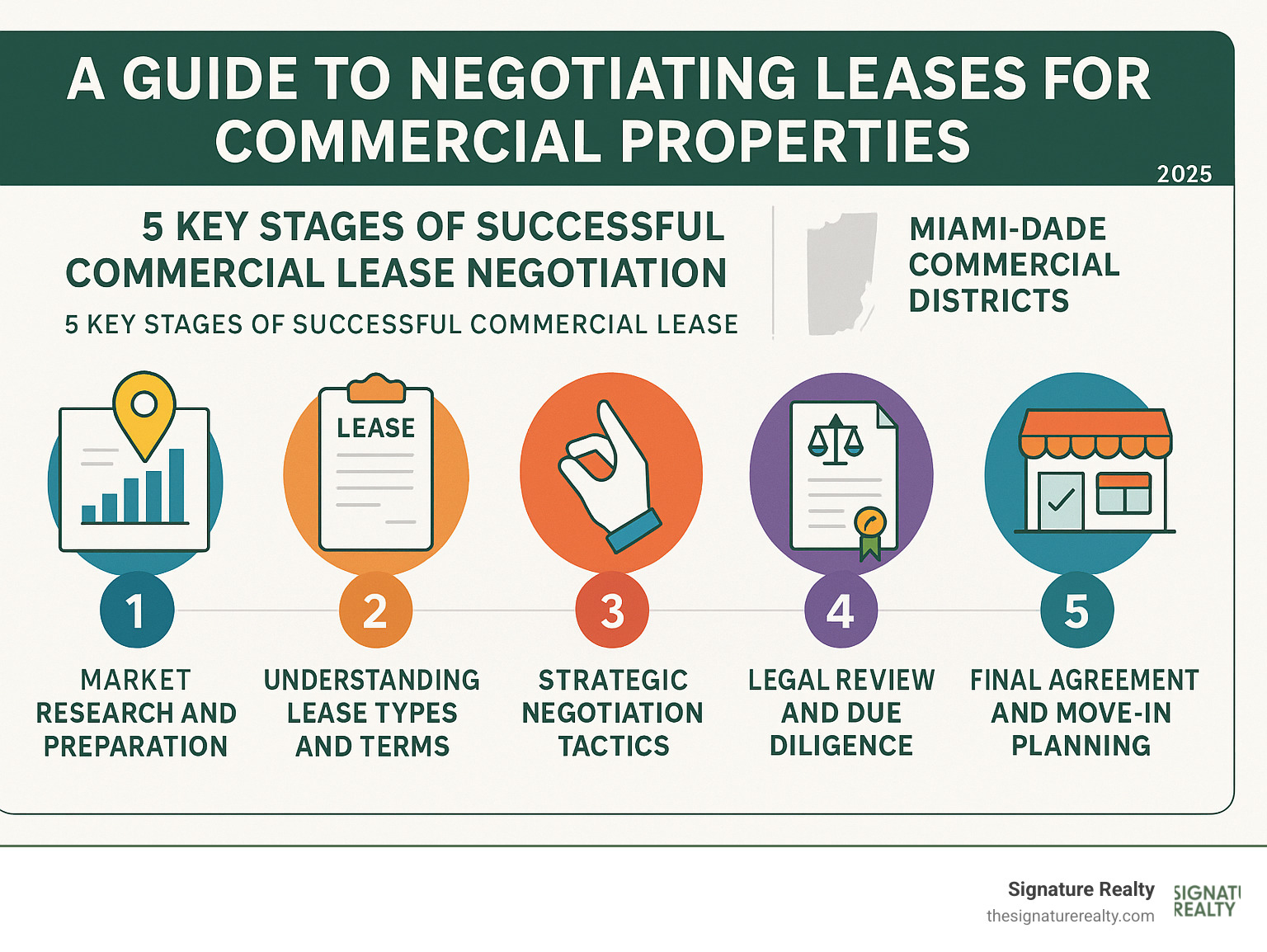
A guide to negotiating leases for commercial properties terms to learn:
- how to negotiate commercial leases that favor tenants
- how to negotiate free rent for a commercial lease
- negotiating a commercial lease renewal
The Ultimate Guide to Negotiating Leases for Commercial Properties
Finding the perfect commercial space is just the beginning – a guide to negotiating leases for commercial properties shows that the real magic happens when you secure terms that actually support your business growth. Think of lease negotiation as building the foundation for your success, not just signing paperwork to get keys.
The South Florida commercial market moves fast, especially in Miami, Doral, Hialeah, and Medley. But with the right approach, you can turn what feels overwhelming into a strategic advantage that saves you thousands of dollars over your lease term.
Step 1: Assembling Your Arsenal – Preparation is Power
Walking into lease negotiations in Miami-Dade without preparation is like showing up to a chess match without knowing how the pieces move. Smart business owners know that the groundwork you lay before meeting with landlords determines your negotiating power.
Know Your Business Inside and Out:
Start by getting crystal clear on what your business actually needs versus what would be nice to have. How much space do you truly require for operations? What’s your ideal layout for productivity?
If you’re opening a retail store in Doral, high foot traffic might be non-negotiable. But if you’re securing warehouse space in Medley, quiet accessibility and loading dock access could matter more than visibility.
Here’s the key: think 3-5 years ahead. Most commercial leases run three to ten years, so consider your growth plans. If expansion is likely, you might want renewal options or rights of first refusal on adjacent space. If your future is uncertain, a shorter initial term with renewal options gives you flexibility without long-term commitment.
Budget Beyond Base Rent:
Many business owners focus only on the monthly rent number, but that’s just part of your total occupancy cost. You’ll also pay for Common Area Maintenance (CAM), property taxes, insurance, and utilities – these can add 20-40% to your base rent. For instance, CAM charges for a Class A office space in Miami’s financial district will be significantly higher than for an industrial warehouse in Medley.
Set your absolute maximum budget for all these expenses combined. In competitive markets like Doral, landlords may push for higher security deposits of 2-3 months’ rent upfront, so factor that into your cash flow planning.
Master the Local Market:
Knowledge becomes your negotiating superpower in South Florida’s competitive market. Research comparable properties in Miami, Doral, Hialeah, and Medley to understand fair market rates. This isn’t about finding the cheapest option – it’s about recognizing good value and identifying your leverage.
Are there many vacant warehouses in the Medley industrial park? That’s a tenant’s market where you can negotiate more aggressively. Is retail space in Doral’s CityPlace scarce? You’ll need different strategies. Pay attention to tenant turnover rates in buildings you’re considering – high turnover in a Hialeah strip mall could signal management issues or unrealistic lease terms.

Due Diligence – Your Safety Net:
Before falling in love with a space, dig into the details that could cost you later. What’s the actual condition of the building? Who handles HVAC maintenance and major repairs? Are there any environmental concerns or code violations?
Check Miami-Dade County zoning requirements for your specific business type. Navigating the specific permitting processes in the City of Miami versus the City of Hialeah can be complex, so it’s crucial to understand any restrictions upfront. If you’re planning renovations, make sure they comply with local building codes – finding issues after signing can derail your timeline and budget.
Get Your Construction Plans Ready:
Smart negotiators come prepared with renovation plans and cost estimates. This preparation helps you negotiate a Tenant Improvement (TI) allowance and secure a rent-free build-out period. For a new restaurant build-out in a competitive Doral shopping center, for example, having detailed plans can be the key to securing a substantial TI allowance from the landlord.
Our Tenant Representation Services provide comprehensive market analysis and strategic preparation support. We use data-driven insights to position you for successful negotiations, ensuring you enter discussions armed with the information needed to secure favorable terms.
Step 2: Decoding the Document – Key Lease Types and Clauses in Florida
Commercial leases read like legal novels, but understanding the key elements can save you from costly surprises. Especially in the diverse markets of Miami-Dade, where a lease for a Hialeah warehouse will look very different from one for a Doral retail shop, every clause is potentially up for discussion.
Understanding Lease Structures:
The type of lease you sign determines who pays for what, making this one of the most important decisions in your negotiation.
| Lease Type | Tenant Responsibility | Landlord Responsibility | Best For |
|Gross Lease | Minimal; usually covers specific internal space maintenance. | Handles property taxes, insurance, common area maintenance, utilities, and major building systems. | New businesses in Miami wanting predictable monthly costs, small office spaces in Doral where simplicity matters more than control. |
| Net Lease | Base rent plus property taxes, insurance, and common area maintenance (CAM) charges. | Building structure, roof, exterior walls, and major system replacements. | Established businesses in Hialeah wanting some control over operating costs, medium-sized retail or office spaces. |
| Triple Net (NNN) Lease | Everything: base rent, property taxes, insurance, CAM, utilities, and often maintenance and repairs. | Typically just the building structure, though this varies significantly by agreement. | Large warehouse operations in Medley, experienced businesses wanting maximum control over their operating environment. |
Critical Clauses That Impact Your Bottom Line:
Base rent seems straightforward, but pay attention to escalation clauses. Annual increases of 2-3% are common in South Florida, but you can often negotiate caps or tie increases to the Consumer Price Index rather than automatic percentages.
Additional rent covers those CAM charges, taxes, and insurance we discussed. Insist on audit rights – you want the ability to review how these charges are calculated and allocated. Some landlords in Miami have been known to get creative with what they include in “common area maintenance.”
Lease term and renewal options give you security and flexibility. A five-year lease with two three-year renewal options lets you stay if the location works while protecting you from dramatic rent increases. In a rapidly developing area like Doral, securing renewal options at a pre-defined rate can protect you from being priced out in a few years.
Security deposits in South Florida typically range from one to three months’ rent. Negotiate for the deposit to be held in an interest-bearing account, and clarify exactly what conditions could result in forfeiture.
Use clauses define what you can do in the space. For a business in a mixed-use development in downtown Miami, a broad use clause is critical to allow for future pivots or service expansions. Make sure the language covers your current business and any reasonable expansions.
Exclusivity clauses can protect retail businesses from direct competition within the same property. If you’re opening a restaurant in Doral, you don’t want the landlord leasing space to a direct competitor next door.
Tenant Improvements and who pays for them varies widely. In older industrial buildings common in Hialeah, you may need to negotiate harder for a Tenant Improvement (TI) allowance compared to a new office tower in downtown Miami, where landlords might offer it as a standard incentive. Get clear on what improvements you can make, who approves them, and what happens to them when the lease ends.
For detailed guidance on Florida-specific lease terms and regulations, our Commercial Lease Agreement Florida resource provides comprehensive insights into local requirements and standard practices.