
Why a Commercial Lease Negotiation Checklist is Essential for South Florida Businesses
A commercial lease negotiation checklist is your roadmap to securing favorable lease terms and avoiding costly pitfalls. Since rent is a major business expense, many entrepreneurs who fail to negotiate effectively get “stuck with major hidden costs.”
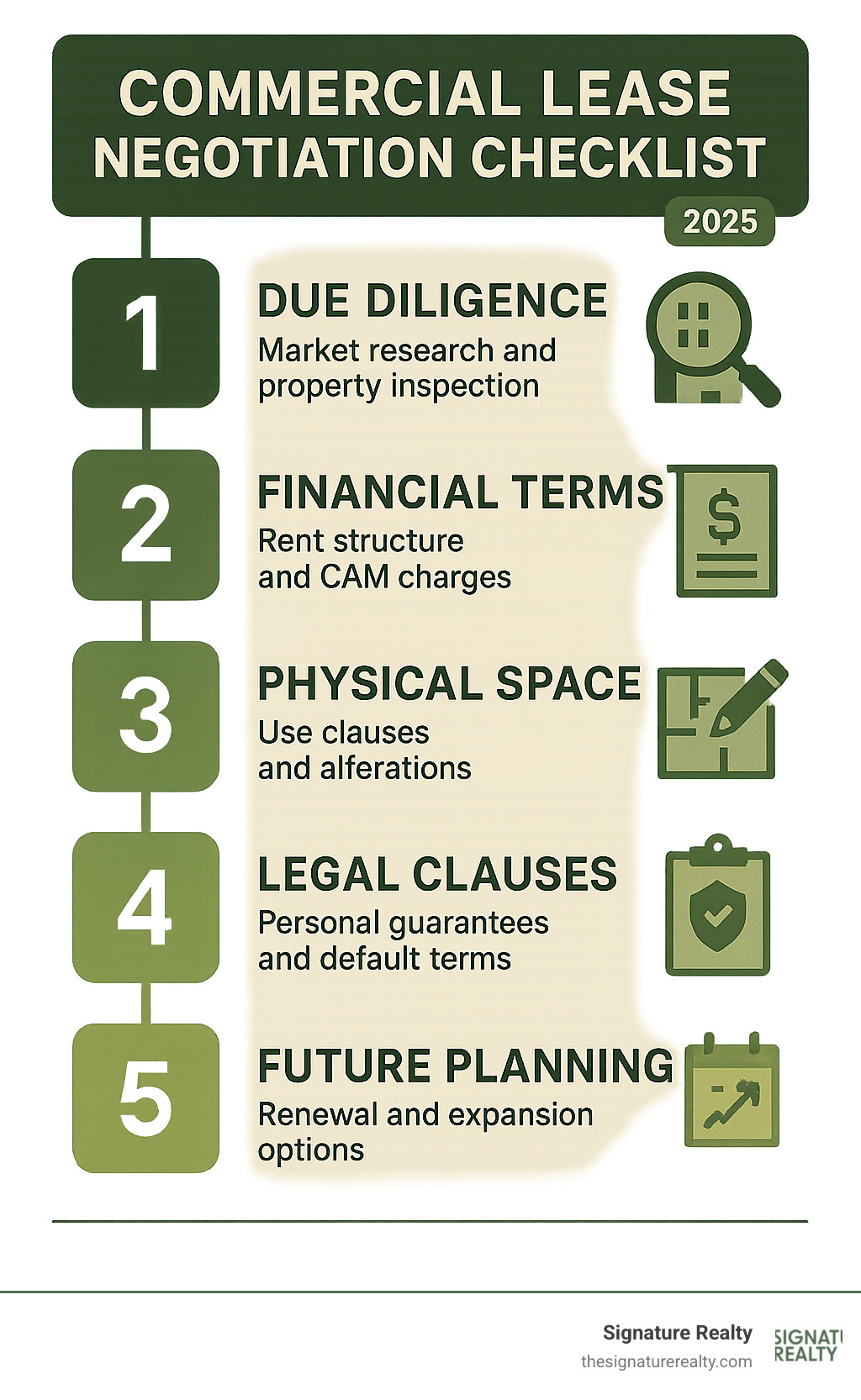
Essential Commercial Lease Negotiation Checklist Items:
- Due Diligence: Research market rates, property condition, and landlord reputation
- Financial Terms: Review base rent, CAM charges, escalation clauses, and TI allowances
- Physical Space: Negotiate use clauses, alterations rights, and parking allocation
- Legal Protections: Examine personal guarantees, default periods, and insurance requirements
- Future Planning: Secure renewal options, expansion rights, and assignment clauses
In competitive South Florida markets like Miami, Doral, Hialeah, and Medley, the stakes are high. Landlord-prepared leases favor the property owner, leaving tenants vulnerable to unexpected costs, restrictive terms, and personal liability that puts your business and assets at risk.
I’m Brett Sherman. Using AI-driven market analysis and proven commercial lease negotiation checklist strategies, I’ve helped hundreds of South Florida businesses steer complex leases. My experience shows that expert guidance can save tenants 15-25% on total occupancy costs while securing better terms.
Commercial lease negotiation checklist glossary:
- a guide to negotiating leases for commercial properties
- how to negotiate commercial leases that favor tenants
- how to negotiate free rent for a commercial lease
Pre-Negotiation: Your Due Diligence Checklist

Pre-negotiation due diligence is a critical part of your commercial lease negotiation checklist. This research is what separates smart tenants from those who overpay. Many Miami business owners walk into negotiations blind, missing opportunities to save significantly on rent. Proper homework is your strongest bargaining chip.
Understanding Your Business & The Market
First, understand your business needs. Know your budget, including potential CAM charges which can add 30% to monthly costs. Define your space requirements, considering future growth plans to avoid costly relocations later. Location is key in South Florida; a restaurant in Hialeah has different needs than a tech startup in Doral. Research comparable rents—our Florida Market Reports show significant variations within Miami-Dade. Analyzing vacancy rates reveals market leverage. Finally, identify your non-negotiables, like specific zoning or parking, to avoid wasting time on unsuitable properties. For insights on finding properties that might not even be on the market yet, check out How to Find Off Market Commercial Properties.
Investigating the Property and Landlord
Next, investigate the property. A physical inspection should assess major systems like HVAC and electrical to avoid future repair costs. Verify ADA compliance and the Certificate of Occupancy to ensure the space is legal for your use. Checking for liens or violations prevents inheriting problems, a key step in Commercial Real Estate Due Diligence. A crucial tip is to talk to current tenants about their experience with maintenance, CAM charges, and management responsiveness. Researching the property management company’s reputation in markets like Miami and Doral is also vital. This investigation provides the leverage needed to negotiate from a position of strength, a cornerstone of a successful commercial lease negotiation checklist.
The Ultimate Commercial Lease Negotiation Checklist: Key Clauses to Scrutinize
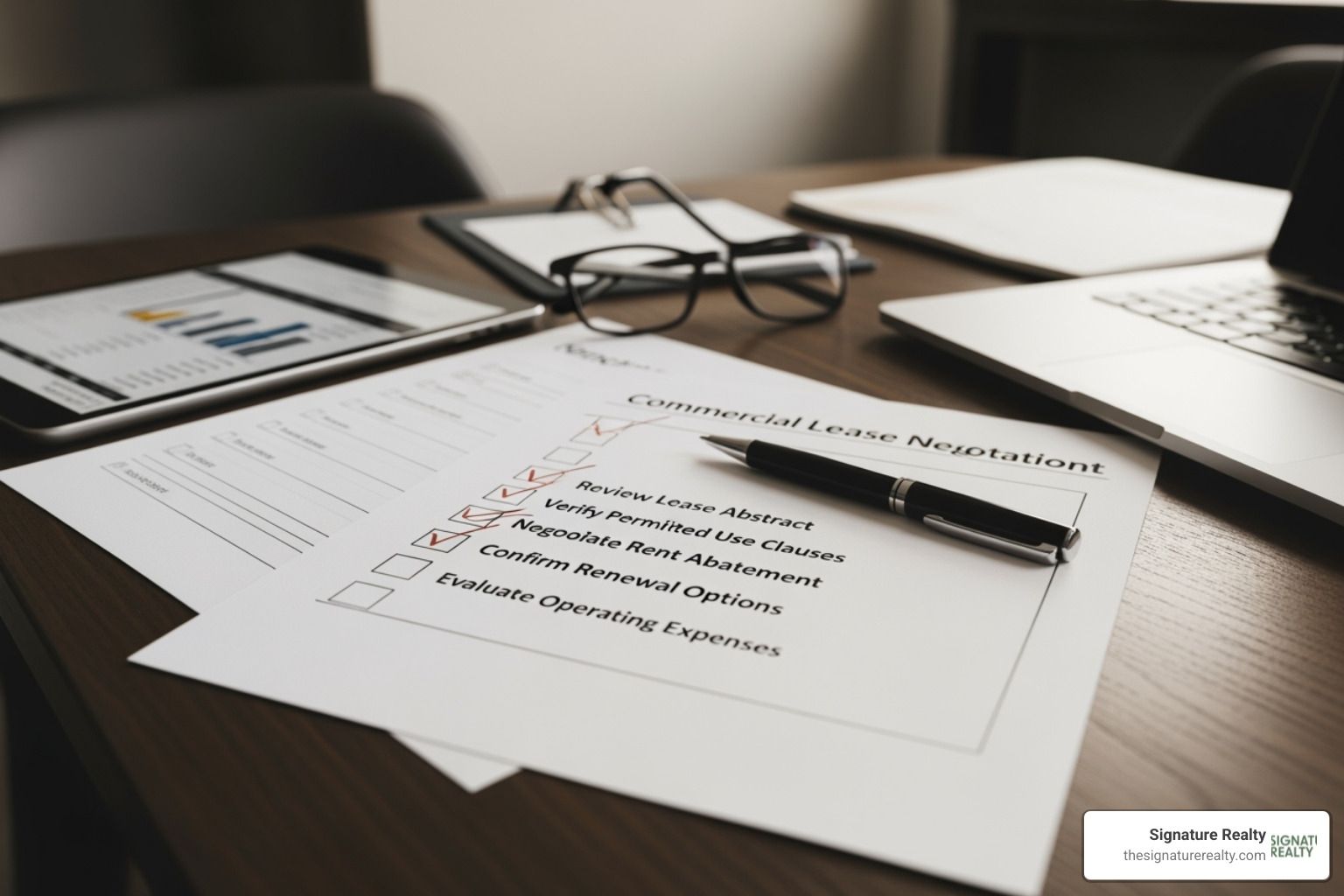
With your due diligence complete, it’s time to review the lease agreement. This is where your commercial lease negotiation checklist is indispensable. Nearly everything in a commercial lease is negotiable. Landlord-prepared “standard” leases are merely starting points. Your goal is to transform that landlord-friendly document into one that protects your business, as every clause impacts your bottom line. For a broader overview, see A Guide to Negotiating Leases for Commercial Properties.
Financial Terms: Your Complete Commercial Lease Negotiation Checklist for Costs
This section details every dollar you’ll owe.
- Base rent: Your monthly payment. Compare it against your market research for areas like Doral or Hialeah.
- Rent escalation clauses: Define how rent increases. Push for predictable, capped increases over CPI-tied bumps.
- Operating expenses (OpEx): Cover property taxes, insurance, and maintenance. Negotiate to exclude major capital improvements like a new roof.
- Common Area Maintenance (CAM) charges: Cover shared spaces. In Miami, these can rise quickly. Negotiate an absolute cap and demand audit rights to verify charges.
- Lease Structures: Understand the differences:
| Lease Type | Who Pays What | Best For |
|---|---|---|
| Gross Lease | Landlord pays most expenses, tenant pays base rent | Predictable budgeting, smaller spaces |
| Modified Gross | Shared responsibility for certain expenses | Medium-sized offices, some retail |
| Triple Net (NNN) | Tenant pays base rent plus taxes, insurance, maintenance | Larger spaces, long-term tenants |
- Security deposits: Should be reasonable (1-2 months’ rent). Negotiate the amount and terms for its return.
- Tenant Improvement (TI) allowances: Landlord funds to build out your space. In South Florida, $30-50/sq ft is common. Ensure it covers hard and soft costs (permits, fees).
- Tenant inducements: Perks like free rent or moving allowances are negotiable. How to Negotiate Free Rent for a Commercial Lease offers more on this.
The Physical Space: Use, Alterations, and Access
These clauses define what you can do in your space.
- Permitted use clause: Ensure this is broad enough for current and future business activities to avoid being locked out of growth.
- Exclusivity clause: For retail in Miami or Hialeah, this is vital. It prevents the landlord from leasing to direct competitors in the same property.
- Alterations and improvements rights: Negotiate freedom for cosmetic changes and a clear approval process for larger modifications. Clarify who pays and if restoration is required at lease end.
- Signage rights: Secure rights for exterior and directory signage. Clarify who pays for installation and removal.
- Parking allocation: In markets like Doral and Medley, this is crucial. Specify the number, location, and cost of parking spaces.
- Relocation clause: This allows a landlord to move you. If you must accept it, negotiate strict conditions and require the landlord to cover all costs.
- Restoration obligations: Negotiate upfront whether you must remove improvements at lease end to avoid expensive demolition costs.
Lease Term, Dates, and Future Options
Timing and future options are key for long-term planning.
- Lease term length: Balance the stability and better rates of a long term against the flexibility of a short one.
- Key Dates: Distinguish between the effective date (signing), commencement date (possession), and rent commencement date (first payment) to avoid paying for an unusable space.
- Renewal options: Secure your ability to stay. Negotiate multiple renewal periods with capped rent increases. Learn more at Negotiating a Commercial Lease Renewal.
- Expansion rights: If you anticipate growth, negotiate a Right of First Offer (ROFO) or Right of First Refusal (ROFR) on adjacent spaces.
- Subleasing and assignment rights: These are your exit strategies. Ensure the landlord’s consent cannot be unreasonably withheld.
Legal & Liability: A Critical Commercial Lease Negotiation Checklist
These clauses protect your business and personal assets from disaster.
- Personal guaranty: This makes you personally liable for the lease. Negotiate to limit your exposure by capping the amount, setting a time limit, or having it “burn down” over time.
- Subordination, Non-Disturbance, and Attornment (SNDA): This essential clause protects you from eviction if the landlord is foreclosed on.
- Insurance requirements: Ensure required coverage amounts are reasonable. Look for a “waiver of subrogation” to prevent insurers from suing each other.
- Indemnification: Limit your liability to incidents caused by your negligence within your specific space, not the entire building.
- Default and cure periods: Negotiate for grace periods (e.g., 3-5 days for rent) and reasonable timeframes (30+ days) to fix other potential violations.
- Landlord access rights: Require reasonable notice (24-48 hours) for landlord entry to minimize disruption to your business.
- Confidentiality: Protect your proprietary data from being disclosed by the landlord, which is crucial in Miami’s competitive environment.
These protections are complex, which is why expert help from our Tenant Representation Services is invaluable.
Conclusion: Partner with an Expert to Secure Your Ideal Space

This commercial lease negotiation checklist highlights the complexity and high stakes of securing a lease. Most business owners are experts in their field, not commercial real estate law, especially in the unique South Florida markets of Miami, Doral, Hialeah, and Medley. Landlord-prepared leases are designed to favor them, shifting costs and risks to you.
Trying to negotiate alone is a significant disadvantage. This is where an expert tenant representative becomes invaluable. At Signature Realty, we’ve spent over 13 years navigating these challenges for South Florida businesses.
Our proprietary AI deal analyzer and data-driven approach set us apart. We use technology to analyze market data and predict negotiation outcomes, a strategy that has saved our clients over $2 million. We help you save 15-25% on occupancy costs and secure critical terms like exclusivity clauses for Miami retailers or expansion rights for growing Doral tech companies.
Your business deserves a lease that protects your interests and supports your growth. Whether you need retail, industrial, or office space in Miami, Medley, or Hialeah, we turn the complexity of lease negotiation into your strategic advantage.
Ready to secure the best terms for your business?