
Why Understanding Commercial Rent Matters in South Florida’s Competitive Market
In Miami-Dade County, rent on commercial property follows complex rules different from residential leases, directly impacting your business’s bottom line.
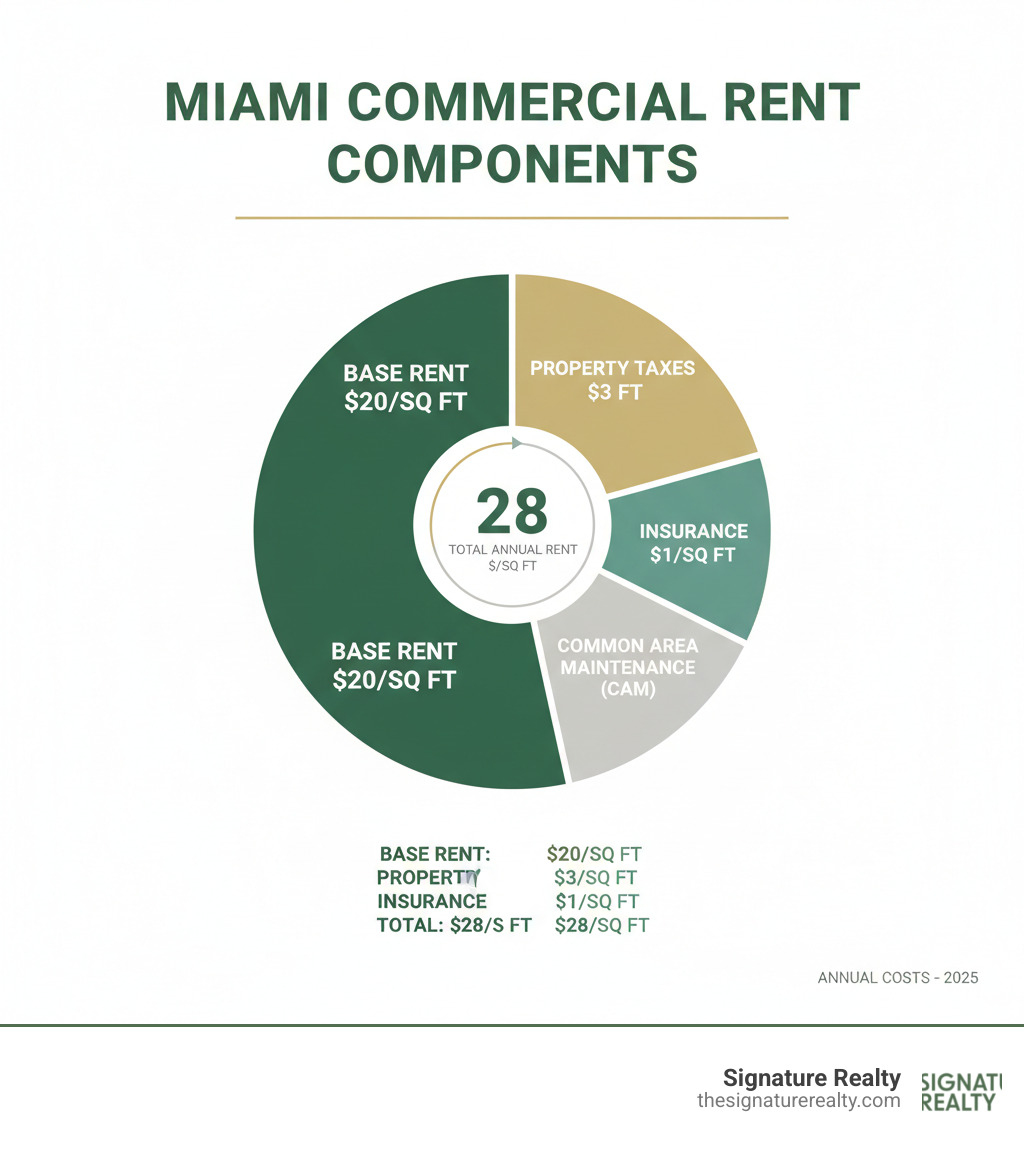
Quick Answer: Commercial Rent Components
- Base Rent: The foundation rate per square foot
- Operating Expenses: Property taxes, insurance, maintenance (CAM)
- Additional Costs: Utilities, parking, common area fees
- Lease Structure: Triple Net (NNN), Full Service Gross (FSG), or Modified Gross
- Total Occupancy Cost: Base rent + all additional expenses = your true monthly payment
As commercial real estate expert Brett Sherman notes, “what seems simple on the surface often hides layers of complexity underneath.” This is especially true in the dynamic markets of Miami, Doral, Hialeah, and Medley.
The difference between a $25 per square foot “gross” lease and a $15 per square foot “net” lease might seem obvious, but the reality is far more nuanced. Operating expenses can add $8-12 per square foot annually to your base rent, changing that attractive $15 rate into a $27 total cost—suddenly making it more expensive than the gross option.
In Miami-Dade, where office rates average $33-46 per square foot and industrial space is $5-11, understanding these costs is essential for smart business decisions.
I’m Brett Sherman. For over a decade, I’ve helped hundreds of businesses negotiate rent on commercial property, using AI-driven market analysis to find hidden costs and secure better terms. Successful leasing requires data-driven insights and expert negotiation.
Basic rent on commercial property glossary:
- a guide to negotiating leases for commercial properties
- commercial lease agreement florida
- how to negotiate a commercial lease agreement
Decoding Commercial Rent in South Florida
Understanding rent on commercial property in South Florida feels like cracking a code. Miami’s office towers, Doral’s industrial parks, Hialeah’s retail corridors, and Medley’s warehouses each have unique pricing.
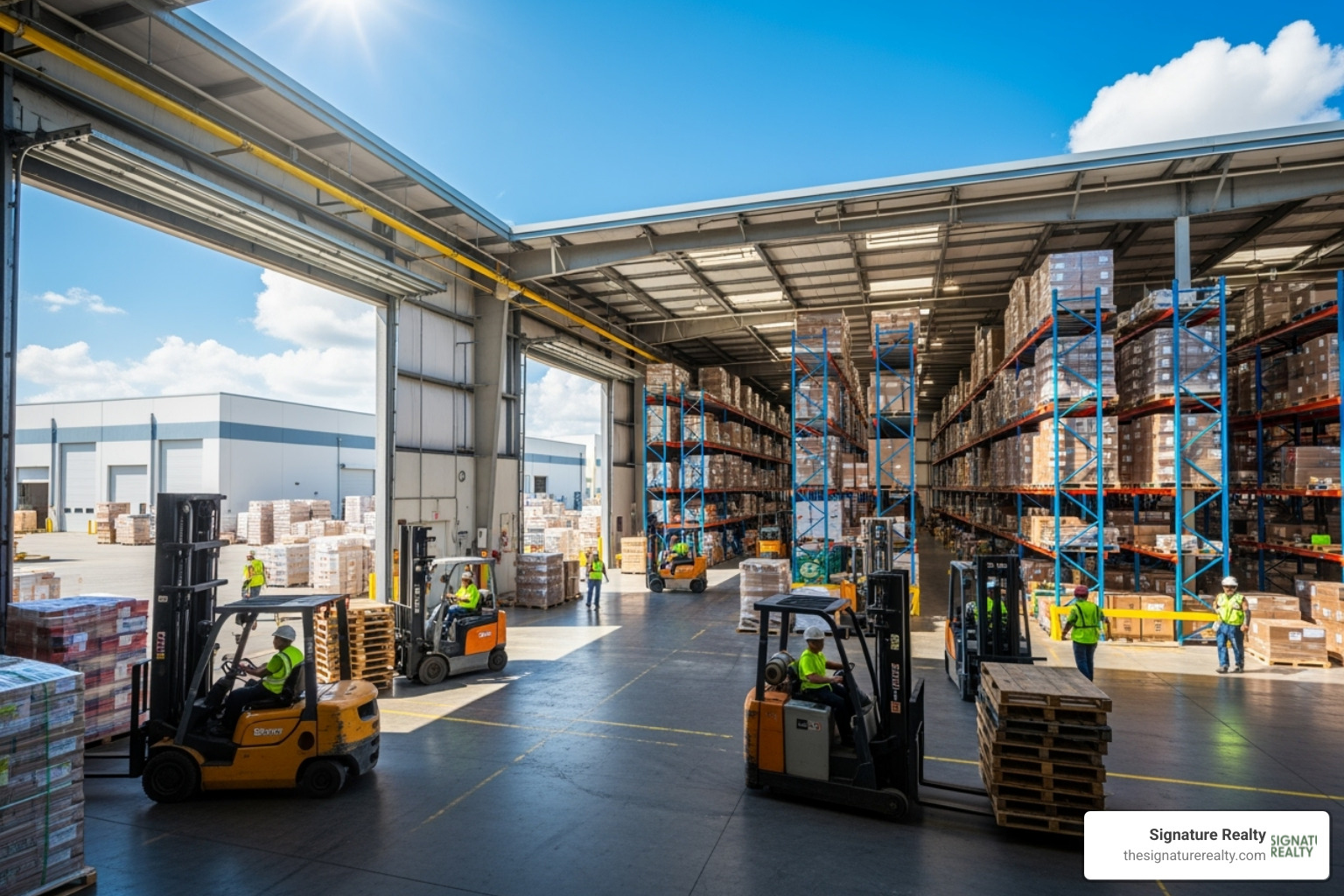
What makes our region particularly exciting is how diverse these markets are. A retail space in Hialeah operates under completely different dynamics than a warehouse in Medley or a tech office in Miami’s Brickell district. Each location is driven by factors like international trade, tourism, and our rapidly growing tech sector.
Once you understand the fundamentals—price per square foot (PSF), lease structures, and market drivers—you’ll be equipped to make smart decisions anywhere in Miami-Dade County.
For businesses new to commercial leasing, I recommend starting with our comprehensive guide on How to Rent Commercial Real Estate.
How to Calculate Rent on Commercial Property
Commercial rent is quoted as an annual rate per square foot (PSF). A “$30 PSF” rate means $30 per square foot per year. For a 1,000 sq ft office at $30 PSF, the annual rent is $30,000 ($2,500/month). But it’s not that simple.
The complexity lies in the square footage calculation. You must know two key measurements:
Usable Square Footage (USF) is the actual space your business occupies—your private office, storage areas, and any space that’s exclusively yours. Rentable Square Footage (RSF) includes your USF plus your share of common areas like lobbies, hallways, and shared restrooms.
The Common Area Factor (or Load Factor) accounts for this difference. In Miami, this can add 15-20% to your usable space, meaning a 1,000 USF office is billed as 1,200 RSF.
For example, a 2,500 sq ft Doral warehouse with a 1.1 load factor has 2,750 rentable sq ft. At $8 PSF, the annual base rent is $22,000 ($1,833/month)—and that’s just the base.
The Building Owners and Managers Association (BOMA) sets industry standards for these measurements.
We also provide comprehensive Real Estate Market Analysis Miami to help you understand current rates and trends.
The Different Types of Commercial Leases
This is where rent on commercial property gets really interesting. The lease structure determines who pays for what beyond the base rent, and those “extras” can add up fast.
| Lease Type | Tenant Responsibilities | Landlord Responsibilities | Common in |
|---|---|---|---|
| Triple Net (NNN) | Base rent + property taxes, insurance, and CAM | Structural repairs, roof and exterior walls | Retail, Industrial, Single-tenant |
| Full Service Gross (FSG) | Base rent (most expenses included) | All operating expenses, utilities, janitorial | Multi-tenant office buildings |
| Modified Gross (MG) | Base rent + some expenses (negotiable) | Some expenses (negotiable) | Office, some industrial |
| Percentage Lease | Base rent + percentage of gross sales | Varies by negotiation | Retail (especially shopping centers) |
Triple Net (NNN) leases, common in Doral and Hialeah, require the tenant to pay base rent plus their share of operating expenses (OpEx): property taxes, insurance, and common area maintenance (CAM). This can add $3-8 PSF to your annual cost.
Full Service Gross (FSG) leases, popular in Miami office towers, include most expenses in the base rent. This provides predictable monthly costs, even if the PSF rate seems higher than an NNN lease.
Modified Gross (MG) leases are a hybrid. The tenant and landlord split certain operating costs. These leases require careful review to clarify who pays for what.
Percentage leases, common in retail, involve a base rent plus a percentage of gross sales over a set threshold. This structure, often seen in Hialeah, can create a partnership where both tenant and landlord benefit from the business’s success.
The key is to calculate your total occupancy cost. For instance, a $12 NNN PSF industrial space in Medley could easily become $18 PSF after adding all expenses.
For legal guidance specific to our state, review our Commercial Lease Agreement Florida resource.
Key Factors Influencing Miami’s Commercial Rental Rates
Rates vary widely based on location, building quality, and market dynamics. Understanding these factors is key to saving money.
Location is paramount. Miami’s urban core (Brickell, Wynwood) commands premium rates. Doral is a logistics hub with rates reflecting its airport and highway access. Hialeah’s vibrant local market is ideal for community-focused businesses. Medley is an industrial powerhouse where functionality and shipping access drive prices.
Building class is crucial. Class A properties offer prime locations and premium amenities, commanding 25-40% higher rates. Class B buildings are a functional mid-range option, often a sweet spot for growing businesses. Class C properties provide basic space at the most affordable rates.
The amenity race in Miami office buildings also pushes rates up. Features like rooftop terraces and wellness centers can add a 10-15% premium.
Market fundamentals like vacancy and supply-demand dictate negotiating power. Low vacancy (<5%) favors landlords, while high vacancy (>10%) gives tenants leverage for better terms, free rent, and improvement allowances.
South Florida’s diverse economic drivers, including international trade, tourism, and the tech sector, create consistent demand and stabilize the market.
We track these trends not just in Miami-Dade, but also in surrounding markets like Warehouse for Rent Broward to give our clients the complete picture.
Navigating Your Lease and Securing the Best Terms
Once you find the perfect space in Miami, Doral, Hialeah, or Medley, the real work begins: negotiation. Understanding rent on commercial property calculations is just the first step.

A commercial lease is a complex legal document written to protect the landlord. Without expert representation, you’re at a significant disadvantage.
This is where strategic tenant representation is crucial. With 13+ years of experience, we’ve saved clients over $2 million by finding hidden costs and negotiating better terms, using our AI deal analyzer to spot opportunities. For a long-term lease worth hundreds of thousands, an expert negotiator is essential.
The key to successful lease negotiation lies in understanding both the current market conditions and your own leverage points. For detailed strategies that work specifically in South Florida’s market, explore our guide on How to Negotiate Commercial Leases That Favor Tenants.
Understanding the Current Miami Market: Trends & Projections
Staying ahead of Miami’s commercial real estate trends is key to getting a good deal.
Office vacancy rates in Miami are healthier than in many US cities due to population growth. Still, the absorption rate (how fast space is leased) varies significantly by submarket, so tenants shouldn’t rush.
The industrial sectors in Doral and Medley are seeing huge demand due to e-commerce and trade, keeping the market tight. This pushes up rent on commercial property but creates opportunities for businesses with flexible location or timing needs.
Retail trends in Miami and Hialeah show a shift. Miami’s high-end districts command premium rents for experiential retail, while Hialeah’s community-focused market remains strong for local businesses.
Watch for sublease space. It often comes at a discount and may include existing improvements, saving you build-out costs.
The future of office space shows a flight to quality. Businesses are prioritizing modern, amenity-rich buildings to attract talent, especially in Brickell and downtown Miami. For deeper insights into how these changes might affect your space planning, check out our analysis of The Future of Office Space.
Essential Considerations for Rent on Commercial Property
Beyond the rent rate, lease provisions can heavily impact your costs. Successful negotiation means knowing what to ask for and which terms to fight for.
Lease term length sets the foundation. Longer terms can yield better rates but reduce flexibility. We often advise balancing stability and adaptability, like a 5-year term with renewal options.
Renewal options deserve special attention. Don’t accept vague “fair market value” renewals. Secure predetermined rates or capped increases to avoid being priced out later.
Tenant Improvement (TI) allowances can make or break your budget. A generous TI allowance can offset a higher rent, especially if you need a custom build-out. Landlords in competitive markets like downtown Miami often use TI to attract tenants.
Escalation clauses determine how your rent on commercial property will increase. Fixed annual increases of 2-3% are predictable. If tied to the Consumer Price Index (CPI), always negotiate a cap to protect against high inflation.
Operating expense management is crucial in NNN leases. Negotiate rights to audit OpEx, cap annual increases, and clarify who controls major repairs. These details have a big long-term financial impact.
Exit strategies matter. Your business needs may change. Negotiate flexible options like subleasing, assignment, or early termination clauses upfront to avoid being trapped in a lease.
Also consider utility arrangements, parking, signage rights, and exclusive use clauses. In Hialeah, parking affects customer access; in Doral, utility capacity can limit operations.
Every provision is potentially negotiable. To avoid common pitfalls, review our guide on how to Avoid Bad Lease Terms Miami: Easy Tips to Protect Your Rental Agreement.
Conclusion: Partnering for Success in Miami’s Market
Mastering rent on commercial property in South Florida is about more than numbers; it’s about fueling your business growth. Every dollar saved on rent and every favorable term gives your business room to thrive.
Too many businesses in Miami, Doral, Hialeah, and Medley stumble through negotiations. They’re surprised by inflated square footage from Common Area Factors, miss out on Tenant Improvement allowances, or agree to uncapped CPI escalations that cripple their budget.
Our 13+ years in this market have shown that expert negotiation backed by data turns these pitfalls into advantages. Understanding the true cost structure of a lease makes you a strategic partner, not just a tenant.
Our proprietary AI deal analyzer reveals market patterns others miss, identifying overpriced listings or better TI packages on similar Doral properties. This tech, combined with our deep local expertise, has already saved our clients over $2 million in lease negotiations.
In South Florida’s competitive market, you need a partner who positions your business for success. The right negotiation strategy for a Hialeah retail space or a Medley warehouse can be the difference between struggling with costs and having the financial flexibility to grow.
Don’t let the complexities of rent on commercial property become a barrier to your business goals. Partner with Signature Realty, and let our proven track record of turning lease negotiations into strategic wins work for you.