
How to Lease Commercial Real Estate: Your 4 Perfect Steps
Your Journey to Leasing Commercial Real Estate in South Florida Starts Here
Learning how to lease commercial real estate involves careful planning, market research, and expert negotiation. The process generally follows these steps:
- Assess Needs: Define your budget, size, location, and feature requirements.
- Search & Tour: Work with a tenant representative to find and evaluate properties and landlords.
- Understand Leases: Learn the differences between Gross, Modified Gross, and Triple Net (NNN) leases.
- Negotiate Terms: Submit a Letter of Intent (LOI) and negotiate rent, improvements, and term length.
- Review & Execute: Have an attorney review the lease, finalize details, and sign.
Unlike renting an apartment, commercial leases are long-term (3-5+ years), complex, and have fewer tenant protections. You’ll negotiate everything from property taxes to early termination penalties. Hidden costs like Common Area Maintenance (CAM) charges and the difference between rentable vs. usable square footage can be significant.
Whether you need retail space in Doral, a medical office in Coral Gables, or a warehouse in Medley, the South Florida market is full of opportunities and challenges. I’m Brett Sherman, and at Signature Realty, we help businesses across Miami, Doral, Hialeah, and Medley steer this process. Using AI-driven market insights and strategic tenant representation, we help clients avoid costly mistakes and secure spaces that support their growth.
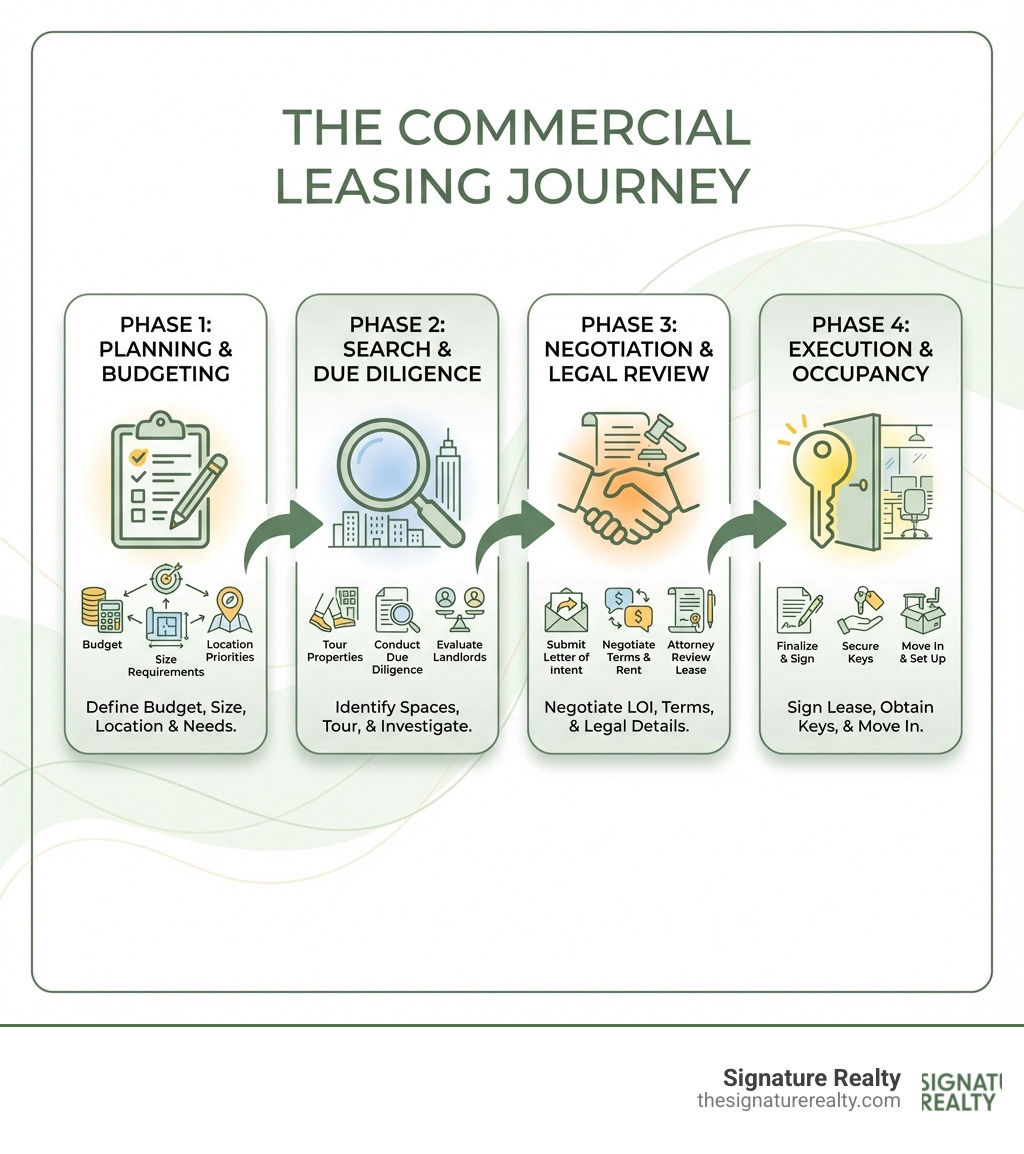
Key how to lease commercial real estate vocabulary:
The Step-by-Step Process for How to Lease Commercial Real Estate in Miami, Doral, Hialeah, and Medley
The journey to securing the perfect commercial space in South Florida is a strategic one that demands meticulous planning and deep market analysis. Our goal at Signature Realty is to guide you through each step, ensuring you make informed decisions that align with your business objectives in Miami, Doral, Hialeah, or Medley.

Phase 1: Assessing Your Business Needs and Financials
Before looking at properties, the first step in how to lease commercial real estate is a deep assessment of your business needs for the next 3-5 years.
-
Define Your Plan and Budget: Your business plan dictates your space needs. Are you a startup expecting rapid growth or an established business seeking stability? This affects size and lease flexibility. Your budget must account for the Total Cost of Occupancy (TCO), which includes base rent plus utilities, taxes, insurance, maintenance, and improvements. Don’t just focus on the monthly rent; the average lease deposit alone can be around $4,000.
-
Determine Size and Location: Understand the difference between Usable Square Footage (USF)—the space you exclusively occupy—and Rentable Square Footage (RSF), which includes your share of common areas and is what your rent is based on. Location is paramount and depends on your business:
-
Identify Required Features: List non-negotiable features like high power capacity, loading docks, or specific ceiling heights. A commercial lease is a significant financial commitment, so ensuring the space aligns with your long-term goals is crucial. For more on office spaces, see our guide on Office Space Miami.
Phase 2: The Property Search and Due Diligence
With your needs defined, we begin the property search and due diligence, a critical part of mastering how to lease commercial real estate.
-
Work with a Tenant Representative: As your tenant representative, Signature Realty advocates for your best interests. We save you time by filtering listings and provide exclusive access to off-market deals. Our proprietary AI deal analyzer uses real-time comparable lease data to negotiate the best terms, a strategy that has saved our clients over $2 million. Learn more about our services at Tenant Representation in Miami.
-
Tour Properties and Conduct Due Diligence: When touring, look beyond aesthetics at the building’s condition, HVAC, electrical, and plumbing systems, and ADA compliance. We recommend bringing a general contractor and a qualified commercial property inspector to identify potential issues that could become costly later.
-
Research Landlords and Zoning: Just as a landlord vets you, you should vet them. We research the landlord’s reputation and financial stability. Most importantly, we verify that local zoning laws in Miami, Doral, Hialeah, or Medley permit your specific business use. You can research property data and zoning via the Miami-Dade County Property Appraiser and Miami-Dade County zoning information.
Understanding the Key Differences: Commercial vs. Residential Leases
Commercial and residential leases are fundamentally different, which is key to mastering how to lease commercial real estate. Commercial leases offer far less regulatory protection, making due diligence and expert negotiation essential.
| Feature | Commercial Lease | Residential Lease |
|---|---|---|
| Term Length | Typically 3-5+ years, a long-term commitment. | Usually 1 year, sometimes month-to-month. |
| Regulation | Less regulated; terms are highly negotiable. | Highly regulated by state/local laws with significant tenant protections. |
| Financials | Tenant often pays for property taxes, insurance, and maintenance (NNN lease). Total cost is much higher than base rent. | Tenant typically pays rent and utilities. Landlord covers most other costs. |
| Negotiability | Highly negotiable; almost every term can be customized. | Generally standardized with limited negotiation. |
Because you, the tenant, are expected to protect your own interests in a commercial lease, expert guidance is vital. For a deeper dive, refer to our Commercial Lease Terms Ultimate Guide.
Decoding the Lease: Common Types and Critical Terms to Know
Understanding lease types and terms is fundamental to mastering how to lease commercial real estate, as they dictate your financial responsibilities.
Common Types of Commercial Leases:
- Full-Service Gross Lease: You pay one all-inclusive rent. The landlord covers operating expenses like taxes, insurance, and common area maintenance (CAM).
- Modified Gross Lease: A hybrid model. You pay base rent plus a share of certain operating expenses, often increases over a base year.
- Triple Net (NNN) Lease: Common in South Florida. You pay a lower base rent plus your share of the three “nets”: property taxes, building insurance, and CAM. This carries more risk but can offer more control. Learn more about Triple Net Lease Properties.
Critical Terms to Understand:
- Base Rent: The fundamental rent for the space.
- Operating Expenses (CAM): Costs for maintaining common areas (lobbies, parking lots). Always review how this is calculated.
- Tenant Improvement (TI) Allowance: Landlord funds to help you build out the space. A key negotiation point.
- Lease Term: The duration of the lease, typically 3-5 years.
- Renewal Options: The right to extend your lease.
- Permitted Use Clause: Defines what business activities are allowed. Keep this as broad as possible.
- Exclusivity Clause: Prevents the landlord from leasing to a direct competitor in the same property.
- Sublease and Assignment: Governs your ability to transfer the lease to another tenant, providing flexibility.
- Rent Increases: Annual increases, often a fixed percentage or tied to the CPI. Negotiate a cap.
- Obligation for Repair: Defines who fixes what (e.g., tenant for interior, landlord for structural/roof/HVAC).
Phase 3: How to Negotiate a Commercial Lease Agreement
Negotiation is the heart of how to lease commercial real estate. Nearly every term is on the table, and this is where our expertise and AI deal analyzer provide a significant advantage in the Miami, Doral, Hialeah, and Medley markets.
1. The Letter of Intent (LOI):
This non-binding document outlines the key business terms before drafting the formal lease. It typically includes the proposed rental rate, lease term, TI allowance, renewal options, and other key clauses. Expect back-and-forth negotiation.
2. Key Negotiation Points:
- Rental Rate & Free Rent: We negotiate the effective rent, factoring in rent abatement (free rent) periods that reduce upfront costs.
- Lease Term & Renewal Options: We align the term with your growth plans and ensure renewal options are clearly defined with favorable rent calculations.
- Tenant Improvements (TI): We negotiate the highest possible TI allowance to fund your build-out.
- Break Clauses (Early Termination): Vital for mitigating risk, these clauses define the conditions and penalties for exiting a lease early.
- Holdover Rent: Landlords can charge up to 250% of your rent if you stay past your lease term. We negotiate this down to a more reasonable rate (e.g., 125%).
- Operating Expenses (CAM): We scrutinize CAM calculations and negotiate caps on annual increases to prevent unpredictable costs.
Using local market data, we can secure favorable terms. For more strategies, see our guide on Commercial Lease Negotiation and tips from the U.S. Small Business Administration.
Phase 4: How to Mitigate Risks and Finalize Your Commercial Lease
The final phase of how to lease commercial real estate involves careful risk mitigation and legal review before you sign.
-
Legal Review: This is non-negotiable. A commercial real estate attorney must review the lease to ensure all negotiated terms are included and to protect you from unfavorable clauses. This is critical as commercial leases lack the built-in protections of residential agreements.
-
Mitigating Financial Risks:
- Personal Guarantees: Landlords often require you to be personally liable if your business defaults. We work with your attorney to limit or cap this liability.
- Holdover Rent Penalties: As mentioned, we negotiate to reduce punitive holdover rates (which can be 125-250% of your rent) during the LOI phase.
- Nondisturbance Agreement: This ensures your lease remains valid even if the landlord defaults on their mortgage, protecting you from eviction.
-
Insurance and Maintenance: The lease will specify your insurance obligations (typically liability and property within your space) and who is responsible for repairs. We ensure these terms are clear to prevent future disputes. An independent insurance agent can provide valuable review; find one via the Insurance Information Institute.
-
Final Walkthrough and Move-in: Before signing, we conduct a final walkthrough to ensure the property is in the agreed-upon condition. After signing, we help you plan the move, coordinate build-outs, and manage the transition to minimize downtime. For more on Florida-specifics, see our Commercial Lease Agreement Florida guide.
Finalizing the Deal: From Lease Execution to Grand Opening
Lease execution is a major milestone, but our support doesn’t end there. We guide you through the final steps to ensure a smooth transition and successful occupancy.
Post-Lease Checklist for a Smooth Transition:
- Setup: Coordinate utilities, IT, and connectivity.
- Permits & Signage: Secure necessary permits and approvals for signage in Miami, Doral, Hialeah, or Medley.
- Move Management: Plan the physical move and any leasehold improvements to minimize operational downtime.
- Landlord Relationship: Foster clear communication with your landlord for a positive long-term partnership.
At Signature Realty, we are your strategic partners in navigating the complexities of how to lease commercial real estate in South Florida. Our 13+ years of experience, exclusive access to off-market deals, and proprietary AI deal analyzer streamline the process and maximize your success. We’ve saved clients over $2 million in lease negotiations and are ready to put that expertise to work for you.
Let us help you find the perfect commercial space to turn your business dreams into reality. Explore our available Lease Properties and contact us today to get started!